

1. Evaluating the Hidden Costs of Legacy Manual Tape Edge Operations
Operational BottleneckLegacy manual tape edging creates severe production bottlenecks on the factory floor, heavily relying on the stamina and skill of veteran operators. When manual workers handle heavy mattress panels across prolonged shifts, fatigue leads to inconsistent stitch lines, stretched binding fabric, and high rates of costly rework.
Labor Dependency Factor
- Operator Fatigue Risk: Manual lifting and turning of heavy inner spring mattresses cause physical strain, resulting in slow cycle times and unpredictable daily output.
- Technical Solution: Upgrading to a modern automatic tape edge system removes physical strain from operators, ensuring uniform speed and steady output throughout the shift.
Scrap & Material Variance
- Edge Material Waste: Uneven manual guiding causes fabric bunching and skipped stitches, forcing operators to scrap entire borders or spend valuable time unpicking errors.
- Technical Solution: Precision mechanical guides and integrated tensioners secure the binding tape evenly, eliminating fabric skew and reducing material scrap to near zero.
2. Sourcing Strategy for High-Performance Automatic Tape Edge Machinery
Equipment SourcingProcuring industrial tape edge equipment requires a rigorous evaluation of mechanical durability, servo control accuracy, and integration potential within your existing assembly workflow. Factory owners must look beyond initial capital outlay and assess long-term operational reliability.
Component Durability
- Heavy-Duty Chassis: Sub-standard frames vibrate at high sewing speeds, leading to premature needle deflection and frequent mechanical maintenance downtime.
- Technical Solution: Select robust, fabricated steel structures equipped with industrial-grade linear guides and heavy-duty sewing heads designed for continuous 24/7 plant operation.
Plant Scalability
- Throughput Alignment: Mismatched machinery speeds create inventory pile-ups between quilting stations and final packaging lines.
- Technical Solution: Invest in modular equipment capable of scaling cycle times to match upstream panel production and downstream wrapping systems.
3. Precision Servo Integration and Automated Corner Deceleration
Motion ControlSewing crisp, professional mattress corners without bunching requires exact synchronization between the conveyor drive and the sewing head. Traditional mechanical clutches lack the fine control needed for high-speed cornering, often resulting in messy overlaps or dropped stitches.
Cornering Dynamics
- Momentum Control: Maintaining high speed around 90-degree corners tears the binding tape and distorts the mattress panel structure.
- Technical Solution: Implement advanced PLC programming that automatically detects corner approaches and triggers smooth deceleration for flawless mitered corners.
Multi-Axis Synchronization
- Speed Discrepancies: Uncoordinated feed rollers and sewing heads cause tension wrinkles along the mattress sidewalls.
- Technical Solution: Utilize fully servo-driven multi-axis controls to lock the sewing speed and material feeding rate into perfect harmonic synchronization.
4. Robotic Flipping Mechanisms and Material Handling Efficiencies
Ergonomic AutomationHandling multi-layer king-size mattresses requires tremendous physical effort from workshop staff. Integrating automated flipping mechanisms directly into the production line transforms heavy manual labor into a seamless, automated workflow.
Handling Bottlenecks
- Manual Rotation Lag: Waiting for operators to manually flip and position heavy mattresses creates idle time for the high-speed sewing head.
- Technical Solution: Deploy pneumatic clamping and automated rotation arms that instantly flip and square the mattress without operator intervention.
Workflow Integration
- Conveyor Continuity: Interrupted transfer between stations disrupts the rhythm of a high-standard mattress tape edge production line.
- Technical Solution: Integrate motorized belt conveyors that feed, center, and eject finished panels automatically, keeping your factory floor running at peak capacity.
Essential Machinery for Scaling Production
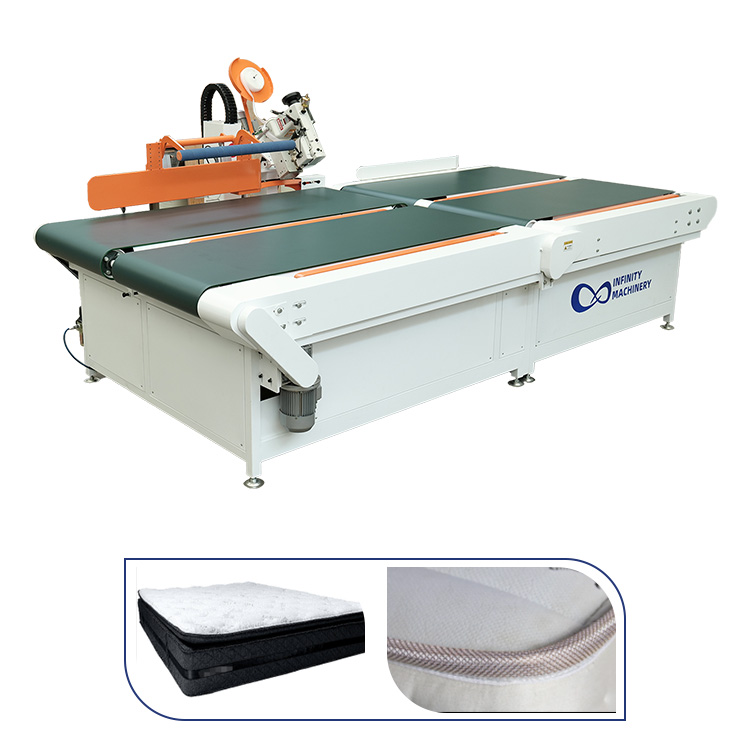
Features automatic rotation, flipping, and robotic arm integration to significantly reduce labor intensity and deliver flawless straight sutures.

Ergonomic design equipped with an advanced servo system for ultra-precise sewing, automatic flipping, and reliable high-volume performance.
5. Plant Floor Layout, Air Pressure, and Pneumatic Infrastructure
Facility IntegrationInstalling high-speed automated tape edge equipment requires careful preparation of your facility's utility infrastructure. Inconsistent pneumatic pressure or poor spatial layout can hinder machine performance and limit daily throughput.
Pneumatic Stability
- Pressure Fluctuations: Low air compressor capacity causes sluggish clamping responses and erratic corner-turning mechanisms.
- Technical Solution: Maintain dedicated regulated air lines supplying consistent pressure (0.6-1.0 MPa) to ensure snappy pneumatic cylinder actuation.
Spatial Efficiency
- Layout Cramping: Inadequate clearance around the tape edge table obstructs material loading and routine maintenance access.
- Technical Solution: Design ergonomic buffer zones around the machine footprint to allow smooth staging of raw panels and rapid removal of finished beds.
6. Preventive Maintenance Protocols and Maximizing Component Lifespan
Maintenance StrategyHigh-speed sewing heads operating at thousands of RPM demand disciplined preventive maintenance to prevent unexpected line stoppages. Establishing routine care schedules protects your capital investment and ensures consistent stitch quality.
Lubrication Protocols
- Friction Wear: Inadequate oil supply to rotary hooks and needle bars accelerates mechanical wear and causes thread breakage.
- Technical Solution: Utilize automated lubrication systems and establish daily oil-level checks before powering up the equipment for a production shift.
Needle & Thread Care
- Needle Deflection: Using dull or incorrect needle sizes at high speeds damages fabric layers and strains the sewing motor.
- Technical Solution: Enforce strict schedule-based needle replacements and use high-grade synthetic threads compatible with heavy-duty mattress construction.
7. Financial ROI Analysis and Reducing Cost-Per-Bed Metrics
Financial EvaluationUpgrading from legacy manual stations to fully automated tape edge machinery delivers measurable financial returns by slashing labor overhead and eliminating costly material scrap. Plant managers can calculate rapid amortization through increased hourly bed output.
Labor Optimization
- Headcount Reduction: Manual tape edging typically requires multiple skilled operators per shift, driving up direct labor expenses.
- Technical Solution: Automation allows a single operator to oversee multiple machines, cutting labor cost-per-bed by up to 50% while boosting overall plant safety.
Throughput Acceleration
- Output Scaling: Slow manual cycle times cap daily factory output and restrict responsiveness to large commercial orders.
- Technical Solution: Automated turnover and servo-driven sewing elevate hourly productivity to 20+ beds per hour, securing faster order fulfillment and higher profit margins.
Strategic Plant Investment Takeaway
Replacing slow, legacy manual tape edge operations with automated, reliable equipment like Infinity Mattress Machinery is the definitive strategy for reducing cost-per-bed, maximizing output per shift, and securing long-term factory profitability.
Ready to Upgrade Your Factory Line?
Consult with our engineering experts to design a custom high-efficiency production layout for your mattress manufacturing facility.


