Facebook

Can a Foam Clamp Cut Block Handling Labor by 70%? The IF-FC Conveying Guide

Can a foam clamp cut block handling labor by 70%? The IF-FC long-block conveying clamp specification, integration with cutting and storage lines, and the labor and safety ROI for foam plants.
Aug 8th,2026 30 Views
MATTRESS MACHINERY SOLUTIONS

Can a Foam Clamp Cut Block Handling Labor by 70%? The IF-FC Conveying Guide

Can a Foam Clamp Cut Block Handling Labor by 70%? The IF-FC Long-Block Conveying Clamp Specification, Integration with Cutting and Storage Lines, and the Labor and Safety ROI for Foam Plants

50 m Block Length 5.5 kW Only 1 Operator 70% Labor Cut
50 m
Max Clamp Foam Length
1.0-2.3 m
Clamp Width Range
5.5 kW
Total Installed Power
70%
Handling Labor Reduction

Executive Commercial Highlight

In a continuous foam plant, the most underestimated bottleneck is not the foaming machine, the cutting line, or the storage yard. It is the manual handling of long foam blocks between those stations. A freshly poured foam block can stretch 30 to 50 meters in length, weigh several tons, and require four to six workers with forklifts and manual winches to move it from the curing area to the horizontal cutting line. The IF-FC Foam Clamp replaces that labor with a single automated clamp that grips the block along its full length and conveys it precisely into the next process. With a clamp length of up to 50 meters, a width range of 1.0 to 2.3 meters, and total power of just 5.5 kW, the IF-FC turns the highest-labor step in foam production into a one-operator operation.

1. The Hidden Cost of Manual Foam Block Handling

Ask any foam plant manager where their labor hours actually go and the answer is rarely the foaming machine. It is the movement of blocks: dragging a 40-meter long, 1,200 mm wide foam block from the curing rail onto the cutting table, repositioning it between cuts, and feeding the compression or storage stages.

Each move requires coordination between a forklift driver, two to three workers pulling straps, and a spotter watching the block ends. A single block transfer can occupy 4 to 6 workers for 15 to 25 minutes, and a plant producing 30 blocks per day spends 8 to 12 worker-hours per day purely on moving material.

That labor is not just expensive; it is also the source of most safety incidents in foam plants. Block ends swing, straps slip, and forklift operators work blind around tall foam stacks. Manual handling injuries account for a disproportionate share of lost-time incidents in the foam industry.

The IF-FC changes this picture at the root. Instead of coordinating people around the block, one machine grips the block along its entire clamped length and conveys it in a straight, controlled path. The result is a 60 to 70 percent reduction in handling labor, a measurable drop in incident risk, and a cutting line that never waits for manual repositioning.

2. Technology Overview: How the IF-FC Clamp Grips and Conveys Long Blocks

The IF-FC is engineered around a simple principle: grip the block across its full length so no segment sags, then move the whole assembly on a powered rail. Unlike forklift forks that support a block at two points, a full-length clamp distributes the grip continuously, protecting soft foam from crushing while keeping the block perfectly straight during transport.

The clamp length is customizable to match your production line, with a maximum clamping length of 50 meters and a width range of 1.0 to 2.3 meters covering standard slabstock block widths. The total installed power is just 5.5 kW because the clamp is a conveyor, not a lifting crane: it travels on rails at floor level instead of hoisting blocks into the air.

Below is the full specification table of the IF-FC foam clamp.

Specification Parameter IF-FC Foam Clamp
Model IF-FC
Clamp Foam Length Up to 50 m (customizable)
Clamp Foam Width 1.0 - 2.3 m
Total Power 5.5 kW
Machine External Size L4800 x W2600 x H1700 mm

Because the clamp rides on floor-level rails, it integrates cleanly into an existing plant layout: the block leaves the curing area, the clamp conveys it to the horizontal cutting machine, and after cutting, the same rail system feeds slabs onward to stacking and storage. No overhead cranes, no fork truck aisle widening, no pit excavation.

The IF-FC is the essential conveying link for long block foam production, and it pairs naturally with the compression and storage stages covered later in this guide.

3. Line Integration: Connecting Cutting, Compression and Storage with One Rail System

A foam clamp earns its keep only when it is part of a continuous material flow. The table below shows how the IF-FC conveying stage fits into a complete foam block processing line.

Processing Stage Without Automated Clamp With IF-FC Clamp Line
Block Transfer to Cutting Forklift + 2-3 workers per move 1 operator, rail conveyor
Repositioning Between Cuts Manual strap pulling, 10-15 min Programmed rail repositioning
Feeding Compression Stage Forklift queue at compressor Direct rail handoff
Block Storage Placement Stacked by forklift, double handling Clamp places blocks in storage lane
Workers per Shift 6 - 8 handling staff 1 - 2 handling staff
Handling Labor Share of Production 15 - 25% of plant labor 5 - 8% of plant labor

When paired with the IF-FCR3 Roll Foam Compressing Machine, the clamp feeds blocks directly into the compression cycle, which reduces block diameter from 700-1500 mm down to 350-750 mm for denser storage and lower freight. The compressed rolls then move to the IF-FS Foam Block Storage system, where blocks are catalogued and retrieved without forklift traffic.

This is the difference between a collection of machines and a production line. The clamp is what turns discrete stations into a continuous flow, and continuous flow is what removes the labor cost from foam manufacturing.

4. Financial Projection: The Labor and Safety ROI of a Clamp Conveyor

The ROI of a foam clamp is measured in worker-hours removed from handling. Consider a mid-size foam plant producing 30 blocks per day with 7 handling staff. The projection below compares the current manual system against an IF-FC conveying line.

  • Current Handling Labor: 7 workers x $550 monthly average = $46,200 of annual handling payroll.
  • Current Daily Handling Time: 8 - 12 worker-hours per day spent on block movement across 30 blocks.
  • IF-FC Reduced Staffing: Handling team drops from 7 to 2 workers, freeing 5 workers for cutting, inspection or other value-adding roles.
  • New Handling Payroll: 2 workers x $550 monthly = $13,200 of annual payroll.
  • Annual Labor Saving: $46,200 minus $13,200 = $33,000 of direct payroll saving every year.
  • Safety Cost Avoidance: Reducing manual block handling cuts the most common lost-time incident category in foam plants; a single serious incident can cost $20,000 or more in downtime, medical and insurance.
  • IF-FC Capital Investment: The clamp conveyor is a fraction of the cost of a cutting machine, typically $8,000 to $15,000 depending on rail length and customization.
  • Estimated Payback: Direct labor savings alone return the IF-FC investment in 3 to 6 months, before counting safety and throughput gains.

The throughput gain is equally important. A cutting line that never waits for manual repositioning runs closer to its rated capacity, and a plant that removes 10 worker-hours of handling per day adds roughly one extra production hour to every shift.

B2B ENGINEERING & TECHNICAL SPECIFICATION

Foam block clamp conveyor: full-length clamping frame with adjustable width of 1.0 to 2.3 meters, clamping length up to 50 meters customizable, floor-level rail system with powered drive, soft-grip clamping surface to protect low-density foam, 5.5 kW total installed power, manual or automated control interface, safety interlocks with emergency stop, and modular rail sections that extend to match cutting, compression and storage line layout.

5. Daily Operations: Running a Clamp Conveyor in the Foam Plant

  1. Set Clamp Width for the Block: Adjust the clamp opening to the block width (1.0 - 2.3 m range), leaving 20-30 mm clearance so soft foam is gripped without crushing.
  2. Position the Clamp at the Block End: Drive the clamp to the leading end of the block on the curing rail and engage the full-length grip.
  3. Convey to the Cutting Line: Run the rail conveyor to move the block to the horizontal cutting machine, maintaining a straight, level path.
  4. Hand Off to the Cutter: Position the block at the cutting start line, release the grip, and let the cutting sequence begin without manual alignment.
  5. Return and Repeat: Cycle the clamp back to the curing area; the next block is already queued on the rail.
  6. Inspect the Clamp Surface Daily: Check the grip pads for foam residue and wear, and clean the rail path of debris.
  7. Monthly Rail Maintenance: Lubricate the drive chain, check rail alignment with a straight edge, and verify the emergency stop circuits.

The entire daily routine is a one-operator job. The clamp does the heavy lifting that previously required a crew, and it does it without the swings, straps and blind spots that make manual handling the most dangerous job in the plant.

6. Featured Infinity Mattress Machinery & Equipment

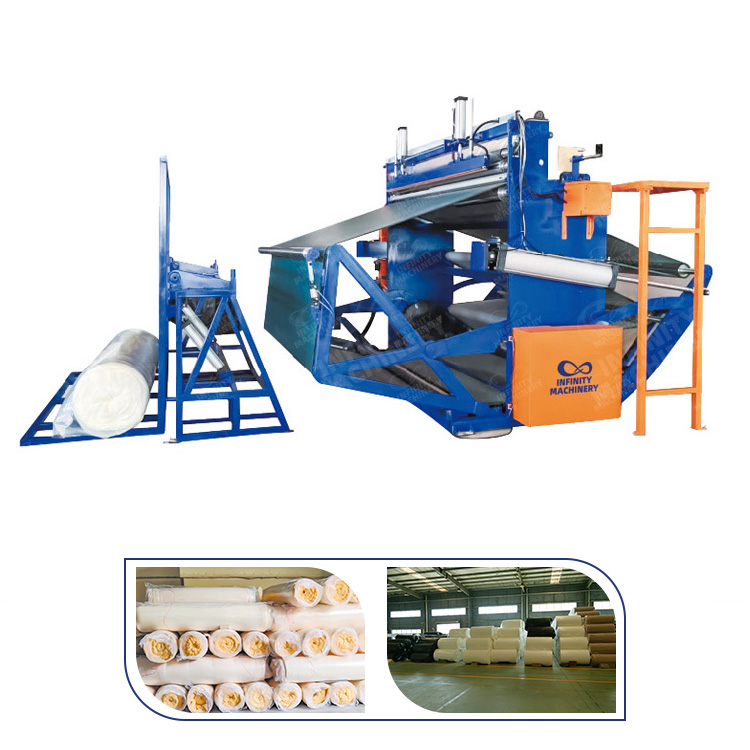
IF-FC Foam Clamp
LONG-BLOCK CONVEYING

IF-FC Foam Clamp

Full-length foam block clamp with up to 50 m clamping length and 1.0-2.3 m width range, replacing forklift and manual handling crews.

View Details →
IF-FCR3 Roll Foam Compressing Machine
COMPRESSION STAGE

IF-FCR3 Roll Foam Compressing Machine

Reduces block diameter from 700-1500 mm to 350-750 mm for denser storage and lower freight cost.

View Details →
IF-FS Foam Block Storage
STORAGE SYSTEM

IF-FS Foam Block Storage

Catalogued foam block storage and retrieval that eliminates forklift traffic and double handling.

View Details →

7. Frequently Asked Questions (FAQ)

Q1: What is a foam clamp and what does it do?
A foam clamp is a full-length gripping conveyor that holds a long foam block along its entire clamped length and moves it on a floor-level rail between production stages, replacing forklift and manual handling crews.
Q2: How much does a foam clamp reduce handling labor?
A plant with 7 handling staff typically drops to 1-2 operators with an IF-FC clamp line, a 60 to 70 percent reduction in handling labor and a saving of 8-12 worker-hours per day.
Q3: What block sizes can the IF-FC clamp?
The IF-FC clamps blocks up to 50 meters in length with widths from 1.0 to 2.3 meters. The clamp length is customizable to match your production line.
Q4: How much power does a foam clamp conveyor use?
The IF-FC uses only 5.5 kW total installed power because it conveys at floor level on rails rather than lifting blocks with overhead cranes.
Q5: Can the clamp feed both cutting and compression machines?
Yes. The rail system hands off directly to the horizontal cutting machine, the IF-FCR3 compression stage, and the IF-FS storage system in one continuous flow.
Q6: What is the payback period for a foam clamp?
Direct labor savings alone return the IF-FC investment in 3 to 6 months, before counting safety incident avoidance and throughput gains.
Q7: Is the foam clamp suitable for low-density foam?
Yes. The full-length soft-grip clamping surface distributes force continuously so low-density foam is held firmly without crushing or sagging.

8. Conclusion: Removing the Highest-Labor Step from Foam Production

Foam plants spend more labor moving blocks than cutting them. Manual handling ties up 15 to 25 percent of plant labor, creates the industry most common safety incidents, and makes the cutting line wait on people instead of running at capacity.

The IF-FC foam clamp removes that bottleneck with a full-length grip, a floor-level rail, and a one-operator routine. Paired with the IF-FCR3 compression stage and IF-FS storage system, it turns a collection of machines into a continuous line. Contact our engineers for a layout study, rail length quotation, and a labor-saving projection based on your daily block output.

READY TO REMOVE MANUAL FOAM HANDLING FROM YOUR LINE?

Contact our engineers today for a foam plant layout study, an IF-FC rail length quotation, and a labor and safety ROI projection based on your daily block output.

Contact Us

We warmly welcome you to partner with us and build long-term benefits through our future collaborations.
Name *
Email *
Message *
Mobile/ WhatsApp *
Country *
Company Name
Leave a message
Name *
Email *
Message *
Mobile/ WhatsApp *
Country *
Company Name
We use Cookie to improve your online experience. By continuing browsing this website, we assume you agree our use of Cookie.