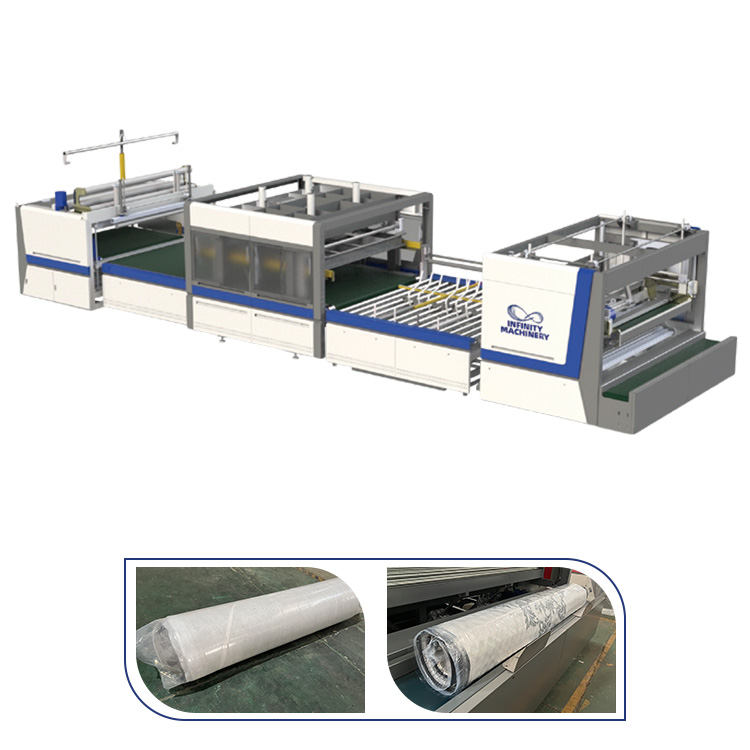
Thick and plus-size mattresses are the hardest units to ship economically: a 450-millimeter pocket spring mattress flat-packed by hand eats almost a third of a container on its own, and over-aggressive compression can flatten spring zones and trigger customer claims. The IF-CR9 Automatic Folding & Roll Packaging Machine solves both problems in one 60-second cycle: it folds the mattress at programmed positions, presses the folded profile, and rolls it into a compact export roll, cutting logistics volume by up to 70 percent while keeping spring structure protected. One operator replaces a four-person folding team, and at a net saving of roughly $8,200 per month after operating cost, the cell pays for itself in about 5.5 months at standard factory utilization.
Folding is where the economics of mattress shipping are decided. A standard queen mattress flat-packed measures roughly 1,530 by 2,030 by 300 millimeters and occupies a container position that could hold four to six compressed units. A plus-size unit at 2,000 by 2,200 millimeters is worse: shipping it flat wastes half a container position, and hand-folding it on the dock is slow, inconsistent, and risky for the spring system. Factories that fold and roll with the IF-CR9 Folding & Roll Packager report that the same container that carried 60 flat mattresses now carries 190 to 220 folded rolls, and the freight cost per unit drops accordingly.
The labor side is just as visible. Folding a thick mattress correctly by hand needs three or four workers, because the unit is heavy, the film must be pulled tight, and the fold positions must be measured by eye. A mid-size plant packing 2,500 units per month keeps a four-person folding crew on the payroll at roughly $5,400 per month including overtime, and still loses time to re-folding and re-taping. The IF-CR9 replaces that crew with one operator who loads the mattress on the infeed conveyor and monitors the automatic fold, press, and roll cycle from the touch panel.
From a commercial engineering viewpoint, the folding-roll cell also protects the revenue stream that compression machines cannot reach. Compression-only packers are ideal for thin foam and standard spring mattresses, but plus-height pocket spring units need a fold-and-roll profile that preserves spring alignment. Because the IF-CR9 programs the fold positions per mattress model, factories can offer 350 to 450 millimeter mattresses on the export market and still keep container efficiency high, which is exactly the product segment where premium margins live.
The IF-CR9 cycle is a three-stage automatic sequence. The mattress enters on the infeed conveyor and the folding station lowers to fold it at the programmed positions, which are stored per model in the Siemens PLC memory. The press stage then squeezes the folded unit to a consistent thickness while the film wrap is applied and heat-sealed, and the rolling station winds the compact unit into an export roll with controlled tension. The complete fold-press-roll cycle runs in about 60 seconds per piece, and the machine accepts mattresses up to 2,200 by 2,000 millimeters with a maximum height of 450 millimeters.
For plants that run standard-thickness mattresses alongside plus-size lines, the IF-CR2 Automatic Roll Packing Machine covers the compression-roll segment at higher speed, and the IF-J6 Semi-Automatic Rolling Machine gives low-volume plants an entry point into roll packing without full automation. The three machines share the same film, seal, and PLC philosophy, so a factory can start with the IF-J6, add the IF-CR2 as volume grows, and deploy the IF-CR9 for the plus-size export range, all with one spare-part and training system.
The critical difference versus simple compression is the fold profile. A spring mattress that is only compressed can lose its edge support and pocket alignment, especially at thicknesses above 350 millimeters; a mattress that is folded at three programmed positions and then rolled keeps its spring columns aligned because the fold lines follow the spring layout, not a random bend. Infinity engineers commission each fold program for the customer's mattress models, which is why the IF-CR9 is delivered with remote setup over the internet rather than a fixed factory default.
Installation takes about two weeks in an occupied factory. The cell needs a level hall bay of roughly 60 to 80 square meters including the machine footprint, film storage, and a one-pallet buffer, with a three-phase 380V supply and standard compressed air. The IF-CR9 remote system lets Infinity engineers commission the fold programs, train the operator, and troubleshoot over the internet, and a full training package for the packing crew is included with the machine.
A complete folding-roll cell deploys one IF-CR9 with an infeed conveyor, film feed, and seal system, and can be paired with the IF-CR2 or IF-J6 for the standard-thickness range. The equipment CAPEX for the cell, including installation, fold-program commissioning, and operator training, typically lands in the range of $36,000 to $42,000 depending on regional freight and accessory scope.
The projection is deliberately conservative. It assumes one shift of packing, no freight-contract renegotiation, and no credit for the plus-size export volume that the fold-roll line unlocks. Factories that move to two shifts or negotiate lower per-container rates once volume drops typically shorten the payback to under four months, while the line continues to run with a one-person crew instead of a four-person crew.
IF-CR9 Automatic Folding & Roll Packaging Machine: fold-press-roll cycle of approximately 60 seconds per piece, accepts mattresses up to 2200 x 2000 mm with a maximum height of 450 mm, Siemens PLC with programmed fold positions stored per mattress model, automatic film wrap with heat sealing, total power of 33.6 KW on a 3-phase 380V/50Hz supply (customizable), machine dimensions of L10300 x W3380 x H2550 mm, net weight of 9000 KG, CE / ISO 9001 compliant components, remote commissioning and diagnostics over the internet, hall bay of 60-80 square meters recommended including film storage and buffer, film and sealing blade consumables of roughly $250 per month at peak utilization, compatible with the IF-CR2 and IF-J6 for the standard-thickness segment.
Layout discipline is what separates a smooth folding-roll hall from a standing queue. The cell must sit at the end of the mattress flow, directly after the tape-edge or quilting output, with a clear path to the pallet station and the container dock, because the folded roll must never cross the production flow on its way to shipping. The recommended configuration below balances machine flow, buffer depth, and dock integration.
The IF-CR9 is engineered for continuous factory duty, with the Siemens PLC and remote system keeping diagnostics, troubleshooting, and firmware updates online rather than on-site. The recurring consumables are PE film, sealing blades, and fold-station pad liners, restocked monthly and costing roughly $250 per month at peak utilization. Structural maintenance is limited to quarterly lubrication and sensor verification, with the press and rolling stations inspected annually.
Total annual operating cost for the cell typically stays under $16,000 including power and consumables, which is less than three months of the labor and freight savings the machine produces. Compared with a manual folding crew whose cost grows with every shift, the automated cell has a nearly flat operating cost curve, which is why fold-roll automation is the first investment that profitable mattress factories make when they enter the plus-size export segment.
The plus-size mattress is the last bulky unit that a mattress factory still folds by hand, and it is the easiest freight dollar to recover. The IF-CR9 folds, presses, wraps, and rolls in one cell, replaces three to four folders with one operator, cuts logistics volume by up to 70 percent, and pays for itself in 5.5 months. The combination of PLC-programmed fold positions, spring-safe folding profiles, and remote support creates a self-running cost machine: fewer hands, denser containers, lower freight, and a new export range in the same hall.
The decision rule is simple: if the factory still hand-folds more than eight hundred units a month or ships plus-size mattresses at flat-pack container efficiency, the folding-roll cell is the highest-return investment available, with a sub-six-month payback and zero compromise on spring quality. Install one cell, measure the freight and labor numbers for one quarter, and let the savings justify the second cell before the shipping dock hits its next ceiling.
Contact our machinery engineers today for a custom folding-roll cell layout, fold-program setup for your mattress models, and a factory-direct quotation for your mattress plant.