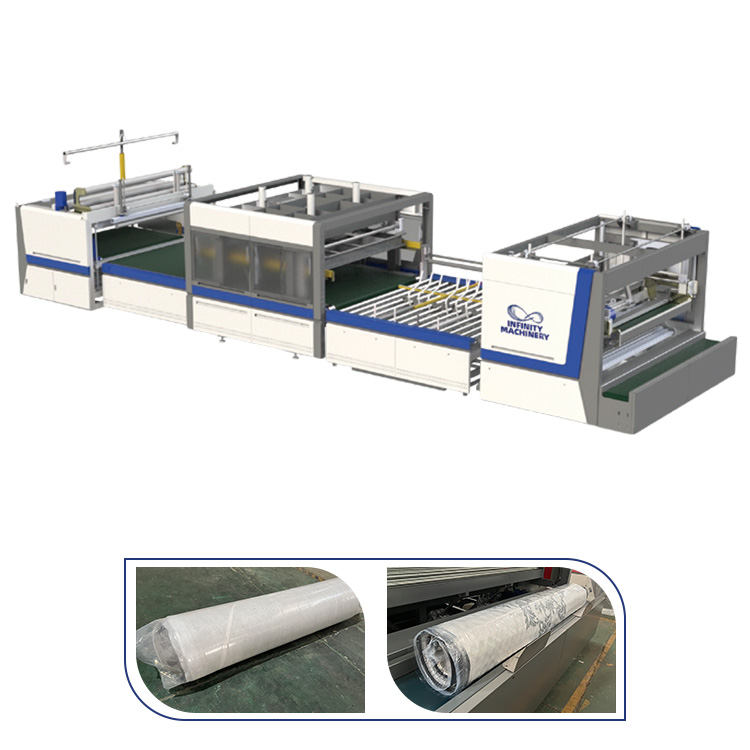
The end of the line is where the mattress factory pays the last labor and loses the last product, and the manual packing is the most labor-heavy step of the whole factory. The crew that wraps the mattress by hand, seals the film, stacks the units and loads the container spends the minutes per mattress, the hand-wrapped package is inconsistent and the stacked units shift and damage each other, and the packing labor and the shipping damage are the two costs that the end-of-line automation removes. The automatic packing line closes the end of the factory: the IF-CR8 Automatic Mattress Compression and Roll Packaging Machine compresses, wraps and rolls the mattress in the automatic cycle, the IF-AMB Automatic Mattress Packing Machine runs the wrapping, the sealing and the compression as the continuous line, and the IF-CR2 Automatic Mattress Roll Packing Machine produces the compact roll for the container, so the operator loads the mattress and the machine finishes the unit, and the end-of-line automation cuts the labor, the inconsistency and the damage at the same step.
The manual end-of-line is the most expensive part of the mattress factory per step, and the labor and the damage hide in the same place. The packing labor is the first cost: the manual wrap needs the crew of the three or four workers, the wrapper holds the film, the second worker turns the mattress, the third seals the ends, and the minutes per mattress multiply by the daily volume into the full crew shifts, so the packing labor is the payroll that the automatic line replaces. The inconsistency is the second cost: the hand-wrapped package varies with the worker and the hour, the loose wrap lets the mattress shift and the tight wrap stresses the corners, and the inconsistent package reaches the customer with the different quality, so the inconsistency is the quality risk of the manual method. The damage is the third cost: the hand-wrapped mattress stacks unevenly on the pallet, the uneven stack leans and sways in the container, the compressed unit that is not properly wrapped loses the vacuum and expands, and the expanding and shifting load damages the corners and the covers, so the damage cost is the claims and the returns that the shipping carries. The handling is the fourth cost: the manual line moves the mattress from the border station to the wrap table, to the stack, to the pallet and to the container, the four moves need the four handling steps, and the handling time and the handling injuries follow the manual flow, so the handling is the labor and the risk of the manual end. The bottleneck is the fifth cost: the manual packing is slower than the automatic production line, the border machine that produces the mattress faster than the wrap crew creates the pile, and the pile at the end of the line backs up the whole factory, so the manual end becomes the bottleneck that caps the output. The manual rule: packing labor, inconsistent wrap, shipping damage, repeated handling and the end-of-line bottleneck are the five costs of the manual end, and the factory that automates the end removes the five at the same step.
The packing automation replaces the manual crew with the machine cycle, and the machine choice matches the volume and the package type. The compression and roll step is the first option: the IF-CR8 Automatic Mattress Compression and Roll Packaging Machine takes the mattress, compresses it under the pressure, wraps it in the film and rolls it into the compact unit, the operator loads the mattress and the machine completes the cycle, and the compressed roll is the stable package that stacks and ships, so the CR8 is the volume workhorse of the automatic packing. The full line step is the second option: the IF-AMB Automatic Mattress Packing Machine runs the wrapping, the sealing and the compression as the continuous line, the mattress enters at one end and the packed unit exits at the other, and the line integrates the steps that the manual crew performed separately, so the AMB is the continuous-flow option for the factory that packs in the line. The roll step is the third option: the IF-CR2 Automatic Mattress Roll Packing Machine specializes in the rolled mattress for the bed-in-a-box, the compact roll maximizes the container density, and the CR2 suits the exporter and the consumer brand, so the CR2 is the density option of the automatic packing. The operator role is the fourth element: the automatic line changes the operator from the wrapper to the loader, the one or the two operators load the mattresses and monitor the machine, and the crew of the four drops to the two, so the operator role is the labor saving of the automation. The speed is the fifth element: the automatic machine packs at the cycle rate of the minute or less per mattress, the line keeps up with the border and the quilting output, and the end-of-line bottleneck disappears, so the speed of the machine unblocks the whole factory. The packing rule: the CR8 for the compressed roll, the AMB for the continuous line and the CR2 for the bed-in-a-box roll, and the factory that matches the machine to the package replaces the crew with the cycle.
The shipping automation finishes the end of the line after the packing, and the palletizing, the labeling and the load complete the flow to the container. The conveyor step is the first element: the packed unit moves from the packing machine to the palletizing station on the conveyor, the conveyor carries the unit without the manual carry, and the conveyor removes the handling step between the packing and the shipping, so the conveyor is the spine of the automated end. The labeling step is the second element: the labeling system prints and applies the shipping label, the product code, the size, the destination and the barcode, and the labeled unit is tracked from the line to the container, so the labeling turns the packed unit into the shippable item. The palletizing step is the third element: the palletizing station stacks the packed units onto the pallet, the robotic or the semi-automatic palletizer builds the stable pattern, and the stable pallet loads the container without the leaning and the shifting, so the palletizing is the damage prevention of the shipping. The wrapping step is the fourth element: the pallet wrap machine wraps the stacked load in the stretch film, the wrapped pallet holds the units together, and the stabilized load survives the road and the ocean motion, so the pallet wrapping completes the protection that the unit packing started. The load planning step is the fifth element: the factory plans the container load by the unit dimensions, the loading plan fills the container without the gaps and the damage, and the planned load reaches the maximum density, so the load planning turns the automation into the freight saving. The shipping rule: convey the unit, label the item, palletize the stack, wrap the pallet and plan the load, and the factory that automates the five ships the stable load with the least handling and the least damage.
The labor and the damage math turns the automation into the payback, and the factory that runs the numbers sees the end-of-line investment pay for itself. The labor math is the first number: the manual packing crew of the four workers at the 15 dollars an hour runs the 480 dollars a day, the automatic line runs with the two operators at the 240 dollars a day, and the labor saving of the 240 dollars a day over the 25 days is the 6,000 dollars a month, so the labor math is the biggest and the most predictable line of the saving. The damage math is the second number: the hand-wrapped load carries the damage rate of the 2 to 3 percent of the shipped mattresses, the damaged mattress costs the replacement plus the claim handling, and the automatic package cuts the rate toward the half, so the damage math adds the claim saving to the labor saving. The handling math is the third number: the manual line moves the mattress four times at the minutes each, the conveyor and the palletizer remove the moves, and the handling time saved is the labor of the moving crew, so the handling math folds into the labor line. The bottleneck math is the fourth number: the manual end that caps the output at the 80 percent of the line capacity loses the 20 percent of the production, and the automatic end that removes the bottleneck recovers the lost output, so the bottleneck math counts the recovered production as the revenue. The payback math is the fifth number: the packing line investment of the 80 to 120 thousand dollars divided by the monthly saving of the labor plus the damage gives the payback of the 12 to 24 months, and the factory with the high volume sees the shorter payback, so the payback math is the decision number of the end-of-line project. The math rule: labor, damage, handling, bottleneck and the payback are the five numbers, and the factory that runs the five decides the end-of-line automation on the monthly saving, not the machine price.
The end-of-line design connects the border machine to the container, and the design that flows the unit through the steps avoids the backtracking and the piles. The first design element is the sequence: the border machine feeds the mattress to the packing machine, the packed unit moves to the labeling, the labeled unit to the palletizing and the pallet to the staging area, and the sequence runs in the one direction with no returns, so the one-way sequence is the base of the end-of-line flow. The second design element is the buffer: the small staging area between the border and the packing absorbs the speed difference, the border machine that runs faster fills the buffer and the packing draws from it, and the buffer prevents the border from waiting for the packing, so the buffer decouples the two speeds of the end. The third design element is the space: the packing machine needs the space for the mattress feed and the unit exit, the palletizing needs the space for the pallet and the fork, and the staging area needs the space for the finished pallets, so the space plan fits the machines and the traffic without the congestion. The fourth design element is the staffing: the one operator loads the packing machine and the second operator runs the palletizing and the labeling, the two-person end covers the flow, and the cross-trained crew covers the breaks and the absences, so the staffing plan matches the people to the stations. The fifth design element is the growth: the end-of-line design leaves the room for the second packing machine, the second palletizer and the longer conveyor, and the factory that grows adds the capacity without the rework of the layout, so the growth plan protects the investment of the end. The design rule: one-way sequence, buffer between the speeds, space for the machines, two-person staffing and the growth room, and the factory that designs the five flows the mattress from the border to the container without the stop.
Contact our team for the IF-CR8, IF-AMB and IF-CR2 packing lines with the speeds and the labor savings that close your factory end-to-end.