MATTRESS MACHINERY SOLUTIONS
How Much Can a Foam Compress Packer Save? The IF-FB02 Export ROI Blueprint
How Much Can a Foam Compress Packer Save? The IF-FB02 Guide: 80T Double Oil Cylinder, L3000xW2000xH1000mm Block Capacity, Freight and Warehouse Savings, and the 5-8 Month Payback for Foam and Mattress Exporters
FOAM COMPRESS SAVINGS IF-FB02 Packing Engine 80T Double Cylinder Export Freight Savings
3,000 mm
Max Block Length
Executive Commercial Highlight
Every foam exporter faces the same math: raw foam blocks ship as mostly air. A 40-foot container of uncompressed foam blocks carries roughly a third of the volume it could carry, which means the freight cost per cubic meter is the single biggest line item in the foam export business. The IF-FB02 Foam Compress Packing Machine is the tool that fixes this: it compresses big foam blocks under an 80T double oil cylinder and heat-seals the compressed package, cutting freight volume by up to 70 percent. This guide covers the real savings, the machine mechanics, the export packing workflow, the freight and warehouse math, and the 5-8 month payback for a foam or mattress exporter.
1. Why Foam Compression Is the Highest-ROI Investment in Foam Export
Foam is the most expensive product to ship per cubic meter in the bedding industry, not because it is heavy but because it is bulky. A block of polyurethane foam is more than 95 percent air, so every container of uncompressed foam pays freight for empty space. Compression changes that equation completely.
The strategic reason is container utilization. A 40-foot container loads roughly 68 cubic meters, and uncompressed foam blocks fill that volume with very little product weight. Compressed and vacuum-sealed foam stacks into the same container at three to four times the product density, so the same freight spend ships three to four times more foam.
The operational reason is that compression is a one-machine change. The IF-FB02 sits at the end of the existing foam cutting and stacking line, compresses each block, seals it with a heat-seal plate and delivers a compact package ready for the container. No change to the foam formula, no change to the cutting line, no change to the sales channel.
2. The Cost and Savings Breakdown: What the IF-FB02 Actually Delivers
Let me break down the real economics of adding a foam compress packer the way I do with export managers before they order anything. The machine itself sits in the $35,000 to $55,000 range delivered and installed, but the savings it unlocks show up in three places: freight, warehouse and damage.
| Cost and Savings Item |
Amount |
Notes |
| IF-FB02 compress packer (installed) |
$35,000 - $55,000 |
80T double oil cylinder, heat-seal plate at 200 deg C |
| Annual freight savings (export container) |
$28,000 - $60,000 |
Up to 70% volume cut on foam block containers |
| Annual warehouse savings |
$6,000 - $15,000 |
Compressed blocks store at 3-4x density |
| Damage and handling savings |
$3,000 - $8,000 |
Sealed packages protect foam from dirt and crushing |
| Installation, training and commissioning |
$2,500 - $4,500 |
On-site setup and operator training by engineers |
| Electricity and consumables |
$1,500 - $3,000 |
Hydraulic power, seal film and maintenance |
The machine pays for itself before the first year of freight savings is complete. A mid-size exporter shipping four containers of foam per month at $7,000 per container saves roughly $2,400 to $3,500 per container with compression, which is $115,000 to $168,000 per year against a $35,000 to $55,000 machine investment.
Factories that already run a mattress roll packer can add the IF-FB02 for raw foam block export, or use it as the first stage before the mattress compression line. The two machines serve different products and both pay back on the same freight math.
3. The Packing Engine: How the IF-FB02 Compresses and Seals Foam Blocks
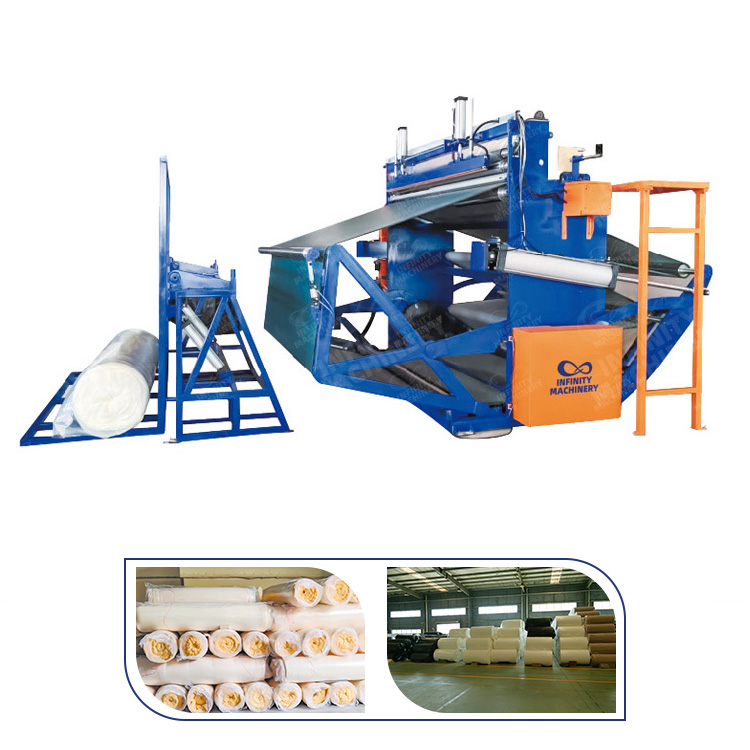
The IF-FB02 Foam Compress Packing Machine is the heart of the export packing line. It takes a big foam block up to L3000xW2000xH1000mm, compresses it under an 80T double oil cylinder, and heat-seals the compressed package so it stays compact through the container journey.
| Specification Parameter |
IF-FB02 Compress Packer |
| Max Compress Foam Size |
L3000 x W2000 x H1000 mm |
| Compression Force |
80T double oil cylinder |
| Seal Heater Plate Temperature |
200 deg C |
| Machine Size |
L9000 x W2500 x H3600 mm |
| Compression Result |
Sealed compact block for container loading |
| Position in Line |
After foam cutting and stacking, before container |
The 80T double oil cylinder is the key spec: it applies even pressure across the whole block face, so the foam compresses uniformly instead of crushing at the edges. Uneven compression creates spring-back that pops the seal open in transit, which is the failure mode that gives compression a bad name in cheap machines.
The heat-seal plate runs at 200 degrees C and welds the film around the compressed block into an airtight package. Airtight is the detail that matters: if air seeps back in, the block re-expands in the container and the whole freight-saving exercise is lost.
4. The Export Workflow and Financial Projection: From Block to Container
A complete foam export packing line runs in five stations, and the compression stage is the one this guide features. The design keeps the foam moving in one direction so no operator walks backward.
- Foam cutting and trimming (station 1): The foam line cuts blocks to order size, typically L3000xW2000xH1000mm or the customer dimensions.
- Block stacking and inspection (station 2): Operators inspect the block face, verify density and dimensions, and stage the block for the compressor.
- IF-FB02 compression (station 3): The block loads into the machine, the 80T cylinder compresses it, and the heat-seal plate welds the film into an airtight package.
- Compressed package handling (station 4): The compact package is weighed, labeled and moved to the staging area, now at a fraction of its original height.
- Container loading (station 5): Compressed packages stack three to four levels high, filling the container with product instead of air.
The financial projection is where the machine pays for itself. A typical export container of uncompressed foam blocks carries about 20 to 25 cubic meters of product in 68 cubic meters of container space. Compressed, the same container carries 60 to 68 cubic meters of product, cutting the freight cost per cubic meter by roughly 60 to 70 percent.
- Freight per Container: A $7,000 container of uncompressed foam becomes the same product volume in roughly $2,500 to $3,000 of container space when compressed.
- Warehouse Density: Compressed blocks store at three to four times the density, so a foam warehouse holds three to four times more inventory in the same footprint.
- Damage Reduction: The sealed package protects the foam from dust, moisture and crushing during handling, cutting return claims.
- Container Turnover: More product per container means fewer container bookings, faster lead times and lower booking risk in peak season.
- Estimated Payback: Between freight, warehouse and damage savings, the IF-FB02 typically pays back in 5 to 8 months.
The payback is even faster for exporters that ship long foam blocks, because long blocks are the worst case for uncompressed freight. Compressing a 3-meter block to a fraction of its height is where the container math improves the most.
B2B ENGINEERING & TECHNICAL SPECIFICATION
Foam block compress packing machine for export: 80T double oil cylinder compression, L3000xW2000xH1000mm maximum block size, 200 deg C heat-seal plate for airtight packaging, L9000xW2500xH3600mm machine footprint, even full-face compression, automatic hydraulic cycle, sealed package prevents re-expansion in transit, digital control panel, and safety interlocks with emergency stop.
5. Daily Operations: The Compress Packer SOP
- Stage the Block: The operator verifies the foam block dimensions and density, then loads it into the IF-FB02 compression chamber.
- Wrap the Film: The block is wrapped with seal film on the open faces, positioned so the heat-seal plate will weld a full airtight seam.
- Run the Compression Cycle: The operator starts the 80T cylinder cycle; the machine compresses the block to the target height and holds pressure.
- Seal the Package: The heat-seal plate welds the film at 200 deg C while the block is under compression, locking the package at its compact size.
- Verify the First Package: Check the seal seam, measure the compressed height and weigh the package against the target for the container plan.
- Label and Stage: The compact package is labeled with product, density and dimensions, then moved to the container staging area.
- Weekly Maintenance: Check hydraulic oil level and pressure, inspect the heat-seal plate surface, verify the cylinder seals and clean the control panel.
The SOP shows why one or two operators run the whole packing stage: the machine does the compression and sealing, and the people do staging, verification and labeling. That split is the difference between a packing line that adds cost and one that adds export margin.
6. Featured Infinity Mattress Machinery & Equipment
EXPORT PACKING ENGINE
IF-FB02 Foam Compress Packing Machine
Compresses big foam blocks up to L3000xW2000xH1000mm under an 80T double oil cylinder and heat-seals the package for container loading.
View Details →
MATTRESS ROLL PACKING
IF-CR5 Mattress Rolling Machine
Full automatic mattress rolling with adjustable diameter for finished mattress export, complementing the foam block compressor.
View Details →
ROLLED FOAM COMPRESSION
IF-FCR3 Roll Foam Compressing Machine
Compresses and packages rolled foam with automatic loading and unloading, ideal for rolled foam export alongside the block packer.
View Details →
7. Frequently Asked Questions (FAQ)
Q1: How much does a foam compress packer cost?
The IF-FB02 foam compress packing machine runs $35,000 to $55,000 delivered and installed, including the 80T double oil cylinder, heat-seal plate, training and commissioning. The freight savings it unlocks typically pay it back in 5-8 months.
Q2: What size foam blocks can the IF-FB02 compress?
The machine handles blocks up to L3000xW2000xH1000mm, which covers the standard polyurethane foam block sizes used across the bedding and furniture industries.
Q3: How much does foam compression save on freight?
Compressing foam blocks cuts the shipped volume by 60 to 70 percent, which translates to roughly the same percentage reduction in freight cost per cubic meter. A $7,000 container of uncompressed foam becomes the same product volume in $2,500 to $3,000 of container space.
Q4: Why does the seal matter for foam compression?
The heat-seal plate welds the film at 200 deg C into an airtight package. If air seeps back in, the block re-expands in the container, undoing the freight savings and risking container overfill.
Q5: Can the IF-FB02 run alongside a mattress roll packer?
Yes. The IF-FB02 compresses raw foam blocks for export, while a mattress roll packer like the IF-CR5 handles finished mattresses. Factories exporting both products run both machines in the same packing department.
Q6: How many workers does the compress packer need?
The IF-FB02-based packing stage runs with one or two operators handling staging, verification and labeling. The compression and sealing are automatic.
Q7: What is the payback period for a foam compress packer?
Between freight, warehouse and damage savings, the IF-FB02 typically pays back in 5 to 8 months for a mid-size foam or mattress exporter.
8. Conclusion: Turning Air into Freight Margin
The foam compress packer is the fastest way for a foam or mattress exporter to cut the single biggest cost in the business: shipping air. The IF-FB02 compresses big blocks under an 80T cylinder, seals them airtight at 200 deg C and delivers packages that load three to four times more product per container.
With freight savings of 60 to 70 percent, warehouse density at three to four times, and a 5-8 month payback, the IF-FB02 pays for itself and then keeps generating export margin from every container. Contact our engineers for a compress packing line layout, an IF-FB02 quotation and a freight savings projection based on your actual shipping volume.
READY TO CUT YOUR FOAM FREIGHT COSTS?
Contact our engineers today for a foam export packing line layout, an IF-FB02 quotation, a machine list and a freight savings projection based on your actual container volume.