A factory owner in Lagos, Nigeria, called me six months ago. He was in a difficult position. "We make mattresses with Bonnell springs," he said. "We sell about 160 units per day. Our spring assembly area has 12 workers manually assembling spring units. I calculated what I pay them last year, including social benefits and overtime. It was $58,000. And the problem is I cannot find skilled assemblers anymore. The young workers do not want this job. My production manager is constantly short-staffed."
His situation is not unique. Bonnell spring assembly has traditionally been a manual process. Workers take individual hourglass-shaped springs and connect them with helical wires to form a spring unit. It is repetitive, physically demanding, and requires consistent attention to detail. A tired assembler produces uneven spring units that cause problems downstream in mattress assembly.
The question he asked me was simple: "Should I automate my Bonnell spring assembly, and if so, what is the real payback period?" This article walks through the exact numbers from his factory, compares three approaches to Bonnell production, and helps you decide which path is right for yours.
Before looking at the Nigeria factory's numbers, it helps to understand the three approaches to making Bonnell spring units. Which one is right depends entirely on your volume and labor situation.
Level 1: Manual assembly. Workers coil individual Bonnell springs on a coiling machine (such as the IF-B90), then manually connect them into spring units using helical wires. This requires 8-12 workers for a factory producing 150 mattresses per day. The coiling machine itself can keep up, but the assembly and connecting steps are slow and labor-intensive. Quality depends heavily on each worker's consistency. In many markets, finding workers willing to do this job is becoming harder every year.
Level 2: Semi-automated assembly. A coiling machine feeds springs into an automatic assembly machine that connects them into units. This reduces the assembly team from 8-12 workers to 2-3 operators. The IF-BA Automatic Bonnell Spring Assembly Machine is designed for this. It takes coiled Bonnell springs and automatically assembles them into complete spring units ready for mattress assembly.
Level 3: Fully automated production line. The IF-B90 coiling machine feeds directly into the IF-BA assembly machine, creating a continuous production line from wire to finished spring unit. Only one operator is needed to oversee the entire line. This is the most capital-intensive option but delivers the lowest per-unit labor cost and the highest consistency.
The Lagos factory had been using Level 1 for years. Twelve workers in the spring assembly area: four on coiling machines producing individual springs and eight on manual assembly connecting those springs into units. Their total monthly labor cost for the spring department was $4,830, including overtime.
But labor was not the only cost. We identified four other costs that were less obvious:
Rework from inconsistent assembly. Manual assembly produces variation. Some spring units are tighter, some looser. When a mattress with an inconsistent spring unit reaches the quilting station, the surface can look uneven. The factory was scrapping or reworking about 3% of spring units. At 160 mattresses per day, that is roughly 5 mattresses per day in wasted material and labor.
Training and turnover. New assemblers take 3-4 weeks to reach full productivity. With a 30% annual turnover rate in the assembly area, the factory was permanently carrying 2-3 workers who were below full productivity. That is a hidden training cost of roughly $400 per month.
Production bottleneck. The assembly area could not keep up with the coiling machines or the downstream mattress assembly line. Whenever an assembler was absent, the whole line slowed down. The factory had to run the assembly area 6 days per week to meet production targets, while the rest of the factory ran 5 days.
Quality complaints from customers. Inconsistent spring units lead to mattresses with uneven firmness. The factory had received three customer returns in the previous quarter specifically citing "uneven surface" or "sagging." Each return cost approximately $85 in shipping, inspection, and either repair or replacement.
When we added everything together, the true monthly cost of manual Bonnell assembly was approximately $6,200 — including $4,830 in direct labor, $500 in rework material, $400 in training inefficiency, and $470 in quality-related costs. Over a year, that is $74,400, and this was not a large factory by any measure.

The IF-B90 Bonnell Spring Coiling Machine is the starting point for any Bonnell spring production line. It is a high-speed coiling machine that produces individual hourglass-shaped Bonnell springs from coiled wire. One IF-B90 produces enough springs for approximately 200 mattresses per day with a single operator. It handles wire diameters from 1.8mm to 2.4mm and produces spring diameters from 68mm to 95mm.
The Nigerian factory already had an IF-B90, which is why they chose to keep it and add the IF-BA assembly machine rather than replacing the coiling side. The IF-B90 had been running reliably for four years with only routine maintenance. Its simple mechanical design means it is easy to maintain and repair locally — important for a factory in Lagos where getting spare parts quickly is a real concern.
One feature of the IF-B90 that operators appreciate is its adjustable spring pitch mechanism. Different mattress models require different spring configurations. The IF-B90 allows the operator to adjust spring height, coil diameter, and number of turns without changing tooling. Changeover between spring specs takes about 15 minutes. For a factory that runs 3-4 different Bonnell spring sizes per week, this flexibility means they do not need dedicated machines for each spec.
The solution for the Lagos factory was the IF-BA Automatic Bonnell Spring Assembly Machine. This machine takes coiled Bonnell springs from the IF-B90 and automatically connects them into complete spring units using helical wires. One operator feeds the machine and one operator handles the finished spring units. That is two people instead of ten in the assembly area.
The IF-BA assembles spring units at a rate of about 75-85 springs per minute, depending on wire gauge and spring diameter. For a standard mattress with around 200 Bonnell springs, that means a complete spring unit is produced every 2.5 to 3 minutes. In a 10-hour shift, one IF-BA can produce enough spring units for over 200 mattresses.
The Nigerian factory installed the IF-BA and the results were measurable from week one. Assembly labor dropped from 12 to 4 people (2 on coiling, 2 on the IF-BA). Monthly labor cost in the spring department went from $4,830 to $1,610 — a saving of $3,220 per month. Rework from inconsistent assembly dropped to near zero. The spring unit quality was consistent because the machine controls the helical wire tension precisely. Customer complaints about uneven surfaces stopped.
The total investment in the IF-BA, including installation and training, was approximately $36,000. Monthly savings were $3,220 plus approximately $500 in reduced rework and quality costs. Payback period: just under 11 months. After that, the IF-BA generates over $44,000 per year in pure savings.
But the owner told me the savings were only part of the story. The real benefit was that he no longer worried about staffing the assembly area. "Before, every Monday I wondered if my assemblers would show up," he said. "Now I have two reliable operators on the IF-BA, and they actually like their job because they operate a machine rather than doing repetitive manual work. My turnover in the spring department went from 30% to 5%."
Here is a quick diagnostic. If three or more apply to your factory, the IF-BA will almost certainly pay for itself within 18 months:
1. You have more than 6 people in your Bonnell spring assembly area.
2. Your assembly area runs 6 days per week while other departments run 5.
3. You have difficulty finding and keeping spring assemblers.
4. You see more than 2% rework or scrap from spring unit inconsistencies.
5. You have received customer complaints about uneven mattress surfaces.
The Lagos factory scored 5 out of 5. Their payback was 11 months. Even a factory scoring 3 out of 5 will typically see a payback under 18 months, making the IF-BA one of the fastest-return investments in a mattress factory.
The Bonnell spring assembly problem is part of a larger pattern in mattress factories. No matter what type of spring you make — Bonnell, pocket, continuous, or zigzag — the assembly step is almost always the labor bottleneck. Factory owners invest heavily in high-speed coiling machines but then bottleneck those machines with manual assembly lines. This is a recurring mistake across the industry.
We see the same pattern in pocket spring factories, where a fast dual-wire coiling machine is paired with a manual assembly table. The coiling machine produces 100 springs per minute but the manual assembly handles only 40, so the factory gets 40 springs per minute of usable output. The coiling machine’s extra capacity is wasted. The solution is always the same: automate the assembly step to match the coiling speed.
The Nigerian factory owner understood this after installing the IF-BA. He is now looking at the pocket spring side of his production and considering a similar upgrade. His takeaway was simple: "The coiling machine was never the problem. The problem was always what happened after the spring was coiled."
High-speed Bonnell spring coiling machine. Handles 1.8-2.4mm wire, 68-95mm spring diameter. Adjustable pitch mechanism, quick changeover. One operator serves 200 mattresses/day.
View IF-B90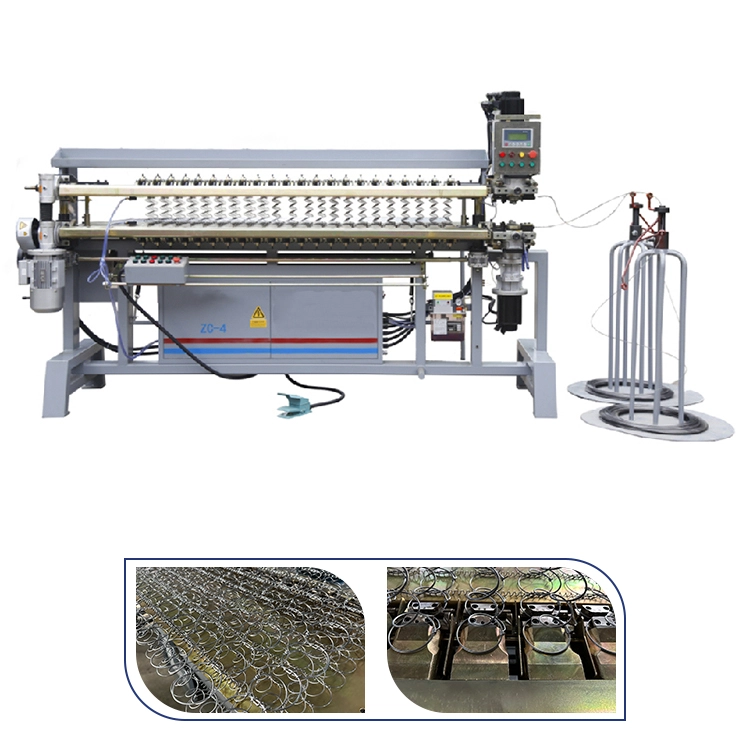
Automatic Bonnell spring assembly machine. 75-85 springs/min, replaces 6-8 workers. Consistent helical wire tension. Payback typically under 12 months.
View IF-BA
Semi-automatic pocket spring assembly machine. Affordable entry into automated spring assembly. Ideal for factories producing both Bonnell and pocket spring mattresses.
View IF-PAIf you are assembling Bonnell springs manually, the question is not whether automation would save you money. It almost certainly will. The question is how fast the payback happens in your specific situation. Based on dozens of factories we have worked with, here are the typical payback periods:
• 50-100 mattresses/day: IF-BA payback in 14-20 months
• 100-200 mattresses/day: IF-BA payback in 8-14 months
• 200+ mattresses/day: IF-BA payback in 5-8 months
The Lagos factory at 160 mattresses per day fell comfortably into the middle range and achieved payback in 11 months. Their experience is consistent with what we see across the industry. The IF-BA is one of the most reliable investments a Bonnell spring mattress factory can make.
If you are making both Bonnell and pocket spring mattresses, the combination of IF-B90 + IF-BA for Bonnell and IF-P130-1 + IF-PA for pocket springs gives you a complete automated spring production capability across both product lines. Many factories start with one system and add the second as they see the results. Either way, the principle is the same: the assembly step is where your labor cost lives, and that is where automation delivers the fastest return.
Tell us your daily output, number of assembly workers, and current labor cost. We will calculate your exact payback period for the IF-BA — no obligation.

