

1. Production Throughput Dynamics in Quilting Line Selection
Throughput AnalysisWhen upgrading legacy equipment, plant directors must evaluate output speed as the primary driver of operational profitability. Modern mattress quilting machines divide fundamentally into high-speed multi-needle arrays designed for continuous mass production and single-needle units tailored for intricate panel designs. Evaluating your daily bed quota per shift dictates whether sheer linear meters per hour or pattern flexibility takes precedence.
Operational Parameter
- Throughput Metrics: Multi-needle systems achieve linear speeds up to 330 meters per hour, making them unmatched for standardized, high-density panel production.
- Technical Solution: Implementing servo-controlled roller feeds ensures seamless fabric progression without slipping or puckering under high-speed operation.
Engineering Analysis
- Cycle Optimization: Balancing shuttle movement with needle bar harmonics reduces mechanical vibration and prevents costly thread breakage during peak velocity runs.
- Technical Solution: Advanced infrared thread break sensors automatically halt production immediately upon failure, minimizing fabric scrap and operator intervention time.
2. Geometric Flexibility and 360-Degree Jump Stitch Capabilities
Pattern PrecisionConsumer demand for luxury beds has escalated the need for complex, independent panel designs that multi-needle bar arrays simply cannot execute. Single-needle quilting heads utilize full 360-degree rotational freedom and advanced jump-stitch programming to create deep-relief custom quilting patterns that elevate perceived retail value.
Design Adaptability
- Pattern Execution: Single-needle architecture allows continuous vector changes, executing complex floral, geometric, and brand-specific logos without mechanical needle constraints.
- Technical Solution: Direct servo-driven saddle and carriage movement eliminates backlash, ensuring exact coordinate registration across thick multi-layer foam panels.
Material Performance
- Foam Compression: Variable presser foot adjustments accommodate high-loft quilting layers up to 80mm thick without distorting delicate top fabrics.
- Technical Solution: Pneumatic pressure regulators apply consistent downward force dynamically adjusted to the local density of the quilted substrate.
3. Mechanical Engineering: Multi-Needle Gangs vs. Single-Head Durkopp Precision
Mechanical DesignThe core mechanical assembly of a quilting machine dictates its long-term reliability and maintenance overhead in harsh factory environments. Multi-needle chain-stitch machines rely on heavy-duty shuttle guide rail support structures, whereas premium single-needle units integrate elite sewing heads like the German Durkopp to guarantee stitch integrity.
Structural Rigidity
- Frame Integrity: Fabricated steel gantry designs absorb the high-frequency kinetic energy generated by simultaneous multi-needle reciprocation.
- Technical Solution: Precision-ground linear guide rails maintain structural alignment over years of continuous multi-shift operation.
Stitch Formation
- Tension Consistency: Maintaining uniform thread tension across dozens of needles prevents loose loops and structural failure during subsequent panel cutting.
- Technical Solution: Utilizing comprehensive mattress quilting solutions with automated lubrication systems drastically reduces thermal wear on internal hooks and needles.
4. Servo-Driven Accuracy and Maintenance Simplicity
Servo CalibrationUpgrading from legacy mechanical clutches to fully computerized, multi-axis servo systems transforms workshop maintenance realities. Modern automated quilting equipment requires less manual calibration, featuring self-diagnostic control panels that alert operators to impending mechanical friction or timing drift before breakdowns occur.
Motion Control
- Technical Solution: Closed-loop feedback encoders continuously report position data to the central PLC, ensuring micron-level pattern repeatability.
Routine Maintenance
- Downtime Mitigation: Accessible grease fittings, sealed bearings, and automated oil distribution channels reduce daily maintenance labor requirements.
- Technical Solution: Modular electronic control boxes allow rapid component swapping by plant technicians, minimizing unprogrammed production halts.
High-Performance Quilting Machinery Solutions
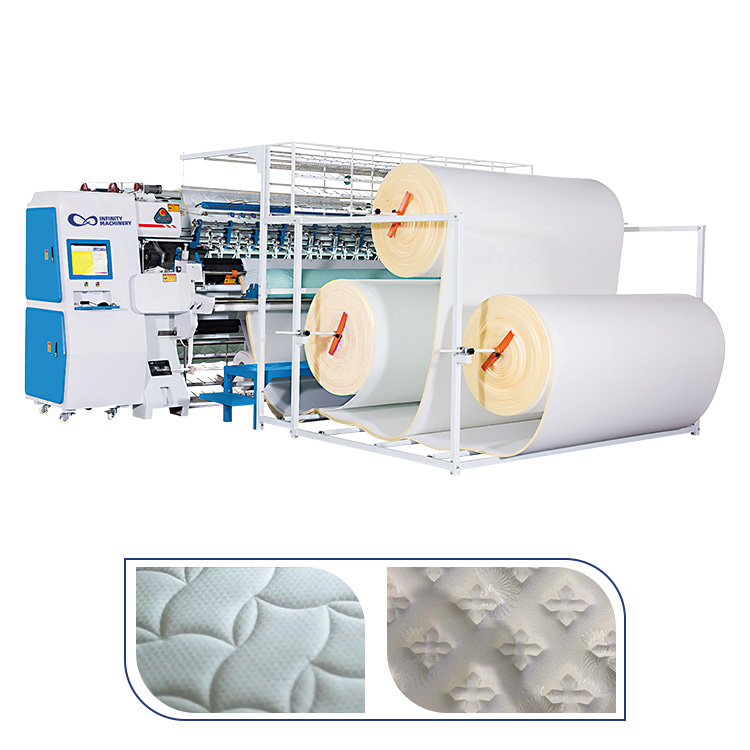
Engineered for high-volume mass production featuring servo-driven rollers, advanced infrared thread break detection, and robust shuttle guide rail support.

Equipped with a German DURKOPP head and 360-degree jump-stitch capabilities, delivering unmatched pattern precision for luxury mattress panels.
5. Economic Impact: Calculating Labor Headcount vs. Capital Expenditure
ROI EvaluationInvesting in advanced quilting machinery directly impacts plant labor economics. Replacing slow, error-prone manual handling and legacy mechanical cutters with automated single-needle or multi-needle lines slashes labor headcount per shift while driving down the manufacturing cost-per-bed to maximize plant profit margins.
Labor Optimization
- Headcount Reduction: Automated material feeding, tensioning, and thread-trimming decrease the reliance on highly skilled, hard-to-find veteran operators.
- Technical Solution: Intuitive touchscreen interfaces allow junior operators to load designs and manage production runs safely with minimal training.
Cost-Per-Bed Analysis
- Scrap Reduction: Eliminating human error in fabric alignment and tension control drastically lowers costly fabric and thread waste.
- Technical Solution: High uptime percentages and rapid style changeovers ensure maximum machine utilization across diverse manufacturing batches.
6. Plant Integration, Floor Space, and Long-Term Durability
Factory WorkflowIntegrating a new quilting machine into an existing factory floor plan requires careful consideration of physical dimensions, power supply requirements, and downstream workflow compatibility with panel cutters and tape edge machines. Heavy-duty cast iron and fabricated steel frameworks guarantee structural longevity under continuous multi-shift production schedules.
Footprint Planning
- Layout Efficiency: Optimizing gantry width and clearance dimensions ensures smooth material flow from quilting tables directly into automated panel cutting stations.
- Technical Solution: Compact integrated console designs minimize floor space consumption while maintaining ergonomic access for operators and maintenance crews.
Durability Metrics
- Thermal Management: Heavy-duty industrial motors and forced-air cooling prevent overheating during continuous high-speed execution of dense quilted assemblies.
- Technical Solution: Rigorous component testing and corrosion-resistant surface coatings protect mechanical assemblies from ambient humidity and workshop wear.
Strategic Plant Investment Takeaway
Choosing between multi-needle output and single-needle precision ultimately depends on your brand's product positioning and production volume goals. Upgrading from aging, breakdown-prone legacy equipment to advanced, automated machinery from Infinity Mattress Machinery is the definitive strategy for reducing cost-per-bed, maximizing hourly output per shift, and securing long-term factory profitability.
Ready to Upgrade Your Factory Quilting Line?
Consult with our industrial manufacturing specialists to engineer a high-throughput, high-precision production setup customized to your plant's exact requirements.


