

1. Emergency Stop Interlocks & Hardware Shutdown Systems
Safety InterlockHigh-speed mechanical assemblies operating at thousands of RPMs require instantaneous hardware response triggers to prevent catastrophic operator injuries during unexpected workshop jams. Legacy machines often suffer from delayed braking, leaving dangerous momentum in heavy quilting heads.
Engineering Analysis: Response Latency
- Core Principle: Dual-channel safety relays disconnect motor power instantly upon physical switch actuation, halting high-inertia components within milliseconds.
- Technical Solution: Modern Computerized Mattress Quilting Machines utilize direct servo feedback loops that bypass sluggish mechanical clutches for immediate emergency halting.
2. Optical Infrared Thread Break & Needle Jam Detection
Optical MonitoringUnnoticed thread snapping or fabric bunching creates severe needle deflection risks under high tension, leading to shattered steel fragments and operator exposure. Continuous optical surveillance removes the need for manual inspection near dangerous needle bars.
Diagnostic Factor: Real-Time Sensing
- Material Insight: Infrared sensors track upper and lower thread integrity continuously, triggering automated stops before tangled yarn causes structural needle failure.
- Technical Solution: Programmable logic controllers instantly cut spindle rotation upon optical trigger failure, preventing high-speed shrapnel hazards in the sewing zone.
3. Automated Presser Foot Deceleration & Thickness Adaptation
Dynamic RegulationMulti-layered panel quilting involves drastic density variations across Pillow-Tops and quilted borders, which can cause unpredictable mechanical binding if presser foot clearances are improperly set manually by operators.
Operational Parameter: Clearance Control
- Core Principle: Software-managed stepper motors dynamically calibrate presser foot height relative to incoming material caliper without manual wrench adjustments.
- Technical Solution: Integrated software protocols automatically decelerate saddle speeds when encountering dense material seams, reducing mechanical shock and pinch hazards.
4. Enclosed Drive Mechanisms & Pinch-Point Shielding
Mechanical GuardingExposed belts, pulleys, and linear guide rails present severe entanglement hazards in aging workshop equipment. Modern industrial design mandates heavy-gauge physical shielding coupled with magnetic safety switches on all service access panels.
Engineering Analysis: Hazard Isolation
- Core Principle: Physical enclosures prevent accidental operator contact with high-torque drive screws and rotating shafts during active production cycles.
- Technical Solution: Interlocked service doors immediately cut power if opened while machinery is energized, ensuring complete compliance with international plant safety standards.
5. Servo-Controlled Positioning & Over-Travel Limits
Motion ControlUncontrolled gantry movement or mechanical over-travel can cause heavy stitching bridges to collide with structural framing, risking catastrophic structural failure and endangering nearby floor personnel.
Diagnostic Factor: Boundary Enforcement
- Operational Parameter: Software-defined travel limits and physical limit switches prevent the carriage assembly from exceeding safe spatial perimeters.
- Technical Solution: Closed-loop servo architecture constantly verifies coordinate positioning, locking axis movement instantly if feedback anomalies are detected.
Essential Machinery Equipped with Advanced Safety Systems

High-efficiency quilting machine featuring a German DURKOPP head and automatic thread break detection, engineered with comprehensive operator safety interlocks.
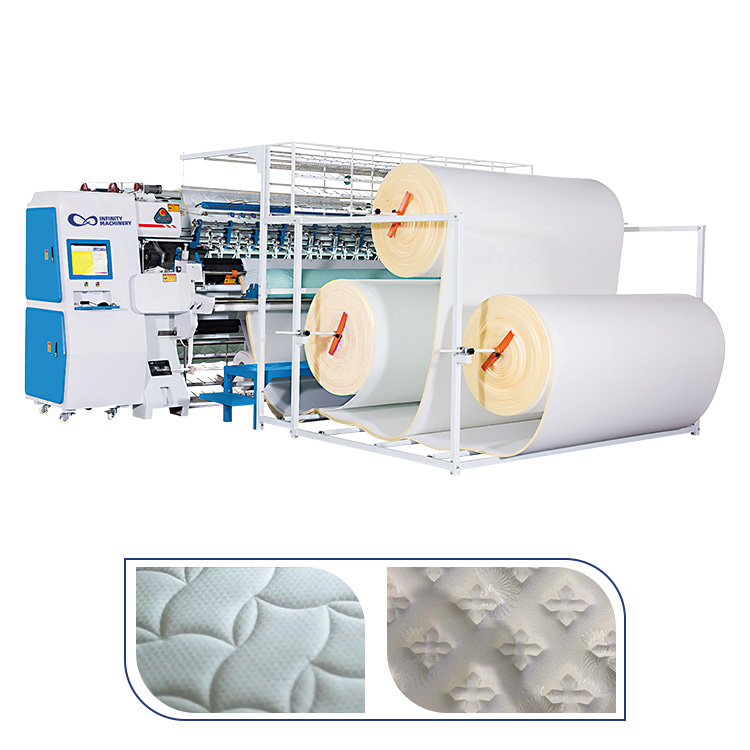
Equipped with advanced infrared detection and servo-driven rollers for high-volume, uninterrupted, and secure quilting production.
6. Operator Ergonomics and Reduced Repetitive Strain Injuries
Ergonomic EngineeringPhysical fatigue directly compromises attention to workshop safety protocols during long manufacturing shifts. Eliminating manual lifting and awkward material positioning protects workforce health while sustaining high hourly output.
Operational Parameter: Fatigue Mitigation
- Core Principle: Automated material feeding and integrated handling arms remove heavy manual strain from factory operators.
- Technical Solution: Streamlining workflow ergonomics ensures workers remain alert, focused, and fully compliant with plant safety guidelines throughout their shift.
7. Routine Electrical Diagnostics and Circuit Isolation Protocols
Electrical SafetyPreventive maintenance safety relies heavily on secure power lockout systems and predictable electronic fault diagnostics to protect technicians servicing high-voltage internal components.
Diagnostic Factor: Circuit Isolation
- Core Principle: Master breaker lockouts and residual current circuit breakers prevent accidental electrical shock during routine maintenance windows.
- Technical Solution: Implementing comprehensive Mattress Manufacturing One-Stop Solutions ensures all electrical enclosures meet rigorous international industrial safety standards.
Strategic Plant Takeaway: Safety as a Profit Driver
Investing in advanced mattress machinery equipped with redundant safety interlocks, automated thread sensors, and fully enclosed drives is not merely a regulatory compliance measure—it is a core pillar of profitable industrial manufacturing. By eliminating catastrophic downtime, protecting skilled labor from injury, and maintaining seamless continuous production, factory owners secure maximum return on equipment investment and long-term operational stability.
Ready to Upgrade Your Factory Safety and Efficiency?
Contact our engineering consultants today to discover how our state-of-the-art machinery can transform your mattress production line.


