Our mattress foam supply business was growing fast — until we hit a wall. Our customers started asking for foam blocks cut to very specific dimensions: 1,830mm × 660mm × 120mm for custom hotel mattresses, contoured sheets for orthopedic overlays, and multi-density blocks for zoned support mattresses. Our basic cutting setup could not handle any of these orders.
We invested in the IF-LT1650 Horizontal Long Track Foam Cutting Machine as our entry-level block slicer, and later upgraded to the IF-CNCH Horizontal Blade CNC Foam Cutting Machine for CNC precision. Together they turned our foam cutting operation from a basic commodity service into a high-value custom foam fabrication business.
Here is the exact story of how these two machines transformed our revenue, our accuracy, and our customer base.
Our company started as a small foam converting operation — buying large buns of polyurethane foam and reselling them cut-to-size for local mattress manufacturers. For the first three years, this was fine. Our customers wanted standard mattress sizes (twin, full, queen, king) and we delivered basic rectangular blocks. We used a simple vertical band saw and a lot of manual labor.
But by year four, the market had changed. Mattress brands wanted more variety — different firmness zones, contoured foam toppers, orthopedic shapes, and non-standard dimensions for their expanding product lines. These custom orders carried 25-40% higher margins than standard blocks. The problem was: we could not cut them.
Here is what our manual cutting process looked like for a custom order:
We had 12 people in the cutting department running two shifts. Our foam waste rate was 14%. And we were still rejecting 1 in 5 custom orders.
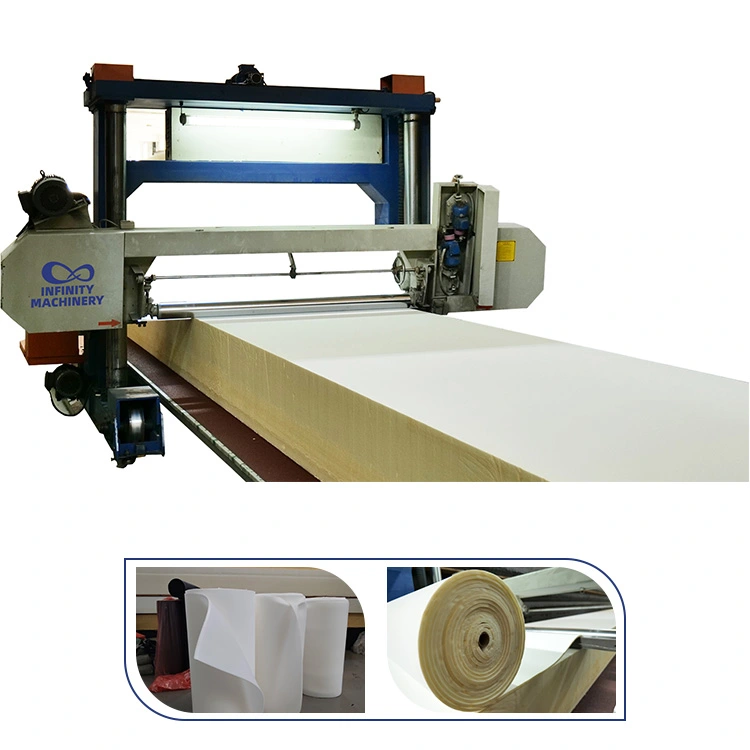
Our first equipment purchase was the IF-LT1650 Horizontal Long Track Foam Cutting Machine. The name says it all: it is a horizontal cutting machine with a long track system that slices through large foam blocks with precision and speed.
Unlike our old vertical band saw, the IF-LT1650 uses a horizontal blade configuration that cuts through the full width of a foam block in a single pass. The long track design means it can handle blocks up to 2,450mm long — far more than our previous 2m limit. The blade runs on a precision guide system that maintains consistent cutting height across the entire block, eliminating the thickness variation our manual process produced.
| Cutting Method | Horizontal continuous blade on long track — single-pass slicing |
| Max Block Length | 2,450mm — handles large foam buns without repositioning |
| Cutting Precision | Consistent thickness across full block width — ±1.5mm accuracy |
| Speed | Full block slice in under 60 seconds — 6-10 blocks per hour depending on size |
| Operation | Simple manual control — one operator after half-day training |
The IF-LT1650 immediately solved our volume problem. Where our old band saw could produce about 15-20 standard block slices per hour with two workers, the IF-LT1650 produced 40-50 slices per hour with one operator. Our daily output of standard foam blocks doubled in the first week.
But it did not solve our custom shape problem. The IF-LT1650 is a straight-line slicer. It is excellent at turning large blocks into flat slabs of consistent thickness — but it cannot cut tapered edges, radius corners, or complex 2D contours. For that, we needed CNC.
Three months after installing the IF-LT1650, we bought the IF-CNCH Horizontal Blade CNC Foam Cutting Machine. This machine takes foam cutting to a completely different level.
The IF-CNCH is a CNC-controlled horizontal blade cutter with three-axis capability (X, Y, C). It connects to a PC, and the operator imports cutting profiles directly from CAD drawings. The machine tracks the cutting path graphically on-screen, allowing the operator to see exactly where the blade will cut before it starts.
| Control System | PC-based CNC with X, Y, C axis command settings — import DXF/DWG files directly |
| Drive System | Servo driver with high-precision guide rails — smooth, low-noise operation |
| Cutting Precision | ±0.5mm on complex contours — clean edges with continuous blade, no burning or melting |
| Custom Shapes | Tapered edges, radius corners, stepped profiles, contoured support zones, orthopedic shapes |
| Optional | Automatic pressure roller system for thin or compressible foam materials |
The difference was night and day. That 1,830mm × 660mm × 120mm block with the 45° taper that used to require 20 minutes of hand-trimming per piece? The IF-CNCH cuts it in 90 seconds, with a perfectly consistent taper angle across every single block. The wavy hand-cut edge was replaced by a smooth, precise finish that looked like it came from a factory 10× our size.
Within two months of installing the IF-CNCH, our custom-order rejection rate dropped from 18% to under 2%. Our foam waste fell from 14% to 4.5% because the CNC controller positioned every cut exactly where it needed to be — no more "cut big and trim down" waste.
Here is the key insight: the IF-LT1650 and the IF-CNCH do different jobs in our production flow, and having both gives us maximum efficiency.
The IF-LT1650 handles the rough cuts — turning incoming foam buns into flat slabs of the correct thickness. This is the high-volume, repetitive work that accounts for about 65% of our total cutting volume. It runs all day, every day, with one operator loading and unloading blocks.
The IF-CNCH handles the precision work — cutting those slabs into final shapes with complex geometries, tight tolerances, and custom profiles. This is the value-added work that carries the higher margins. It runs about 60% of the time, with the remaining capacity available for new custom-order projects.
This two-machine system replaced 10 of our 12 cutting staff. We now run the entire foam cutting department with two operators: one on the IF-LT1650 and one on the IF-CNCH. The other 10 workers were redeployed to higher-value roles in mattress assembly and quality control — and our total output increased by 40%.
| Metric | Before (Manual) | After (LT1650 + CNCH) |
|---|---|---|
| Cutting department staff | 12 | 2 |
| Foam material waste rate | 14% | 4.5% |
| Custom-order rejection rate | 18% | 1.8% |
| Custom taper edge cutting time | 20 min | 90 sec |
| Annual labor cost (cutting dept) | $168,000 | $64,000 |
| Custom-order revenue (monthly) | $22,000 | $87,000 |
Annual labor savings: $104,000. Waste reduction savings: $38,000. New custom-order revenue: $780,000 annually. Combined equipment cost: approximately $42,000. Payback: 4.2 months on labor and waste alone — the new revenue was pure upside.
Based on our experience, here are the three machines every foam cutting operation should evaluate. The first two are what we run today. The third is the natural next step for factories scaling toward full automation.
If we had to share the most important lessons from our journey, here is what we would tell any factory thinking about upgrading their foam cutting line:
1. Start with the IF-LT1650, add the IF-CNCH when custom orders justify it. The long track cutter solves your volume problem immediately at a lower investment. Once you have stable high-volume production, the CNC machine opens the custom-order market. This two-step approach minimizes risk and builds revenue at each stage.
2. CNC precision dramatically reduces waste. Our manual process had a 14% waste rate because of measurement errors, over-cutting, and rejected pieces. The IF-CNCH brought that down to 4.5% — and most of that 4.5% is edge trim that can be recycled with a IF-FFS3 Foam Crushing Machine. For a factory processing $250,000 worth of foam per year, that 9.5% waste reduction is $23,750 straight to the bottom line.
3. Custom orders are where the money is. Before the IF-CNCH, custom orders were 12% of our revenue and our most frustrating process. After the IF-CNCH, custom orders are 38% of revenue and our highest-margin product line. The CNC machine did not just cut foam — it changed what kind of company we could be.
4. Operator training is minimal. We were worried that CNC would require skilled programmers. The reality is different: the IF-CNCH uses a PC control system with graphical tracking. Our existing foam cutters learned to operate it in three days. The most time-consuming part was teaching them to read CAD drawings — not operating the machine.
If any of these describe your operation, it is time to upgrade:
The IF-LT1650 and IF-CNCH are the two machines that took us from a struggling manual cutting operation to a precision foam fabrication business. The IF-LT1650 handled the volume, the IF-CNCH handled the complexity, and together they transformed our entire operation. If your factory is ready for that transformation, these two machines are the place to start.
Eighteen months ago, our foam cutting department was a cost center with 12 people, high waste, and constant frustration. Today, it is our highest-margin operation with two people running machines that produce more than our old 12-person team ever could.
The IF-LT1650 gave us the volume. The IF-CNCH gave us the precision. Together, they gave us the ability to say "yes" to every custom order that comes through the door — and the margins that come with it.
The total investment was $42,000. The first-year return was over $140,000 in labor and waste savings alone — not counting the $65,000 per month in new custom-order revenue we would have had to reject without the IF-CNCH. If you are on the fence about upgrading your foam cutting operation, let these numbers make the decision for you.
Our engineers can help you choose between the IF-LT1650 and IF-CNCH based on your production volume and custom-order mix. Get a customized ROI projection for your factory.