Manual packing is where most mattress factories quietly lose money. A finished mattress that took ten machines and twenty minutes to build can still be ruined in the last ninety seconds by a tired operator, a loose wrap, or a crooked stack. The IF-BCR8 Full Automatic Mattress Packer closes that gap. It is a single, self-contained cell that compresses, wraps, labels and stacks a mattress with no operator touching the product — turning your most inconsistent station into your most predictable one. This guide explains exactly what it does, how it fits a line, and what it is worth to your factory.
The IF-BCR8 is a fully automated packing cell built for the final stage of mattress manufacturing. Where a traditional line hands a finished mattress to two or three workers who fold, compress, wrap and tape it by hand, the IF-BCR8 performs every one of those steps inside one enclosed, PLC-controlled station. The operator loads a mattress at the infeed conveyor; the machine does the rest and delivers a tight, square, labeled package at the outfeed.
"Full automatic" means there is no manual intervention between loading and palletizing. Compression, folding, film wrapping, edge sealing, labeling and stacking are sequenced by a central controller. The machine handles spring, foam, latex and hybrid mattresses within a wide thickness range, and it switches between roll-pack and flat-pack modes through the touch screen without mechanical changeover.
For factories already running an automatic tape edge machine and a CNC foam cutting center, the IF-BCR8 is the natural final piece: it converts a half-automated floor into a genuinely lights-out packing zone. Many of our customers install it as the last upgrade in a multi-year automation plan, and it is frequently the upgrade with the fastest payback.
Understanding the cycle helps you see where the savings come from. A single mattress moves through six stations without ever being touched by a worker:
Because the sequence is fixed and sensor-guided, the 90-second cycle time is the same at 8 a.m. and 8 p.m. That consistency is the real product of automation — not just speed, but predictability.
The numbers below are the standard configuration. We tune power, platen size and conveyor length to your mattress dimensions and target output during the quotation stage.
| Parameter | Specification |
|---|---|
| Model | IF-BCR8 Full Automatic Packer |
| Packing speed | Up to 120 pcs / hour |
| Compression ratio | Up to 1:5 (≈80% volume reduction) |
| Suitable mattress | Spring, foam, latex, hybrid; 80–400 mm thickness |
| Power | ≈ 15 KW |
| Air pressure | 0.6 – 0.8 MPa |
| Control system | PLC + 10" touch screen HMI |
| Wrapping material | PE film (kraft paper optional) |
| Machine size | L 6000 × W 1200 × H 1800 mm |
| Weight | ≈ 2500 kg |
Buyers often ask how the IF-BCR8 compares with our other packing machines. The honest answer is that they serve different points on the automation curve, and many factories run more than one:
| Feature | IF-BCR8 | IF-CR2 | IF-AMB | IF-Y7 |
|---|---|---|---|---|
| Automation level | Fully automatic, one cell | Roll packing, semi-assisted | Automatic packer | Compress + pack combo |
| Operators needed | 1 (load only) | 1–2 | 1–2 | 1 |
| Throughput | Up to 120/hr | Up to 60/hr | Up to 60/hr | Up to 90/hr |
| Packaging mode | Roll or flat, switchable | Roll | Flat / folded | Compressed bundle |
| Best for | High-volume, consistent output | Roll-pack exporters | Mid-volume lines | Space-limited shops |
If your priority is maximum hands-off throughput on a single line, the IF-BCR8 is the answer. If you mainly ship rolled mattresses overseas, the IF-CR2 roll packer is often the better first step. Most of our largest customers run the IF-BCR8 as the flagship and keep a IF-CR5 rolling machine or IF-Y2 compressor on a second line.
Manual packing looks cheap because the labor is already on the payroll. But the hidden costs accumulate fast: inconsistent wrap quality that causes shipping damage, slow operators at the end of a shift, and floor space occupied by pallet-building queues. Full automation attacks all three at once.

The flagship hands-free packing cell — compress, wrap, label and stack in one station.
View product →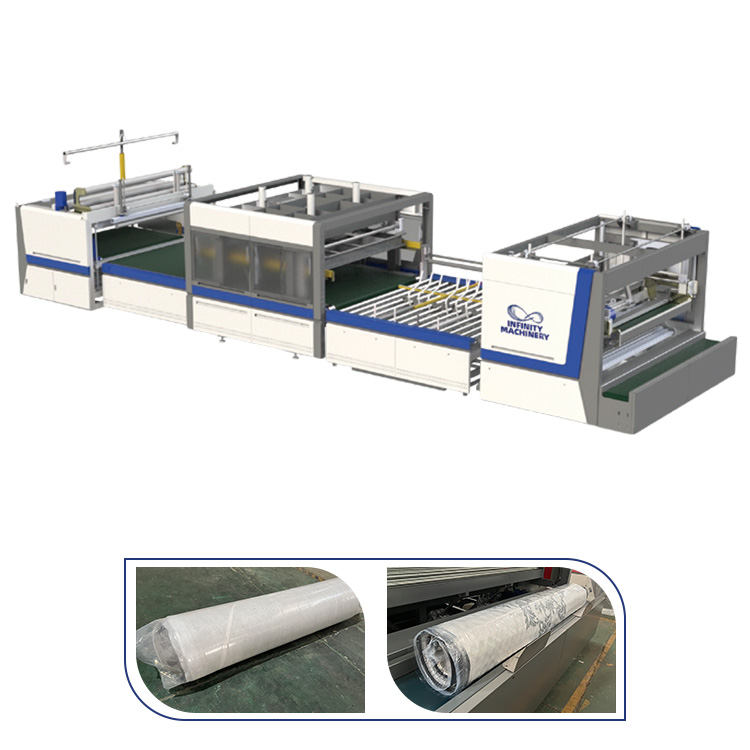
The proven roll-pack exporter's choice for compact, shippable mattresses.
View product →
An all-in-one compressor plus packer for space-limited workshops.
View product →The IF-BCR8 rarely works alone. In a modern mattress plant it sits at the end of a chain that begins with foam cutting and runs through quilting, tape edging and compression packing. The value of the IF-BCR8 is that it removes the human bottleneck right before the warehouse, so the entire line upstream can run at its own pace without a packing queue forming.
We typically integrate it with a conveyer bridge from the tape-edge machine and a roller outfeed into the palletizing area. Because the controller speaks standard Modbus and can accept line signals, it drops into most existing layouts without custom controls work.
A fixed sub-90-second cycle means daily output is a number you can put in a schedule, not a hope.
Reassign freed packers to quality and finishing, where their judgment actually protects margin.
Square, sealed, labeled the same way every time — fewer claims, happier distributors.
One cell replaces a packing bay and a pallet queue, giving floor space back to production.
A Malaysian bedding manufacturer came to us shipping 4,000 mattresses a month with eight people in the packing bay. Damage in transit ran near 5%, and the packing area was the only station that regularly missed its daily target. We installed one IF-BCR8 cell fed by their existing tape-edge line.
Within six weeks the packing headcount dropped from eight to two (one loader, one pallet supervisor). Output rose from roughly 40 mattresses per hour to 105, and transit damage fell below 1%. The two reassigned workers moved to a new inspection step that improved first-pass quality on the quilting line. The machine paid for itself in just under eleven months — faster than the fourteen-month figure they had modeled.
Most factories recover an IF-BCR8 in ten to fourteen months. The math is straightforward: take the loaded hourly cost of the packers you remove, multiply by shifts and working days, then add the freight you save from denser container loading. For a plant removing the equivalent of 2.5 full-time packers at, say, $6,000 per year each, that is $15,000 a year in labor alone — before counting damage reduction and freight density.
Freight is where the biggest number often hides. Compressing and squaring packages to a consistent shape can add one or two extra mattresses per cubic meter of container. On a 40-foot booking that difference is frequently worth more per month than the labor savings. We model this for you during the quotation so the payback period is a forecast, not a guess.
The IF-BCR8 is built for a rough factory environment. Bearings and seals are standard industrial grades, the film path is accessible without tools, and the PLC logs fault codes on screen so most stoppages are diagnosed in minutes. We supply a spare-parts list sized for twelve months of operation and remote support that can walk your technician through 90% of issues on a video call.
Because the machine is one cell rather than a line of separate units, there is only one controller to learn and one maintenance routine to keep. That simplicity is a quiet advantage that your maintenance team will appreciate after the first year.
Can the IF-BCR8 handle both rolled and flat packaging?
Yes. Mode switching is done on the touch screen and requires no mechanical changeover, so you can run export roll-packs in the morning and flat-packs for domestic orders in the afternoon.
What mattress types are supported?
Spring, foam, latex and hybrid mattresses within roughly 80–400 mm thickness. We confirm your exact range during quotation.
How many operators does it need?
One person to load at the infeed and one to supervise palletizing. Many lines run with a single shared operator across two cells.
Does it integrate with my existing line?
In most cases yes. It accepts standard line signals and Modbus, and we bridge it from your tape-edge or compression stage during installation.
What is the typical payback period?
Usually ten to fourteen months, counting labor savings plus denser container loading. We provide a written forecast before you order.
Is training included?
Yes. On-site commissioning includes operator and maintenance training, plus remote support afterward.
Choosing the right IF-BCR8 configuration starts with three questions: what is your daily mattress volume, what packaging mode do your customers require, and how much floor space can you dedicate to packing? High-volume exporters usually want the full automatic cell with a robotic palletizer. Smaller shops often pair a single cell with a manual pallet table. We will size the platen, conveyor length and film system to your real product mix rather than a catalog default.
The IF-BCR8 Full Automatic Mattress Packer is the difference between a packing bay that varies by the hour and one that performs the same all day, every day. It compresses, wraps, labels and stacks with no operator touching the product, cuts labor by up to 70%, and pays for itself inside a year for most plants. If packing is the bottleneck — or the risk — in your line, this is the upgrade that removes it. Talk to our team for a configuration sized to your mattresses and a written ROI forecast.
Get a configuration sized to your mattresses and a written ROI forecast in one business day.

