Custom foam fabrication used to mean a skilled operator, a template, and a hand-held blade — slow, inconsistent, and impossible to scale beyond a few hundred units. The IF-CNCV CNC Contour Sponge Cutting Machine replaces that craft with a servo-driven vertical knife that traces any 2D CAD profile through a foam block to ±0.3 mm tolerance. This guide explains where vertical-knife contour cutting wins, how it compares to the IF-CNCVH double-blade CNC machine and the IF-CNCH horizontal-blade cutter, and why it has become the default choice for medical, automotive, and acoustic foam applications.
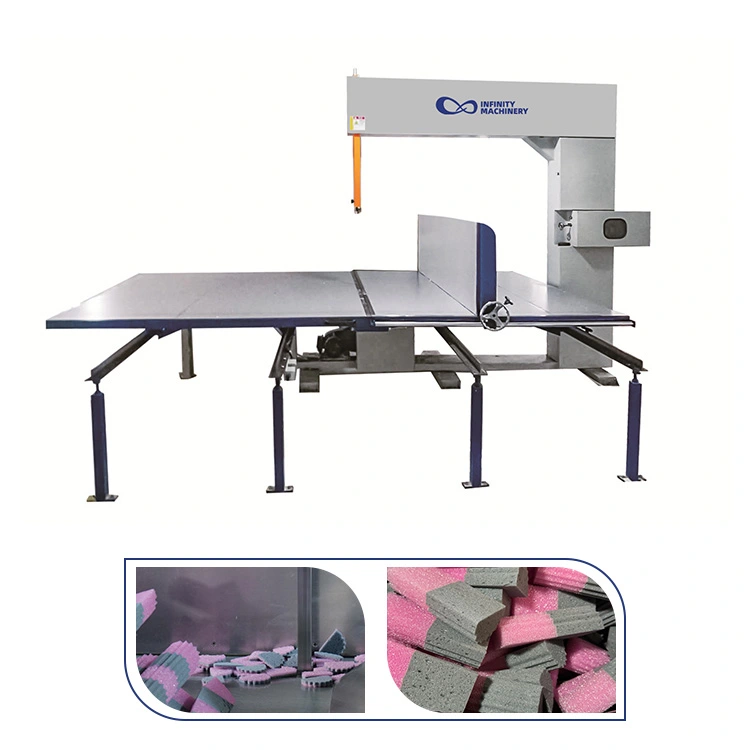
A vertical-knife CNC contour cutter is, mechanically, a gantry that moves a continuously-driven blade through a foam block along a toolpath generated from a 2D CAD file. The blade is a thin, flexible band — typically 8-12 mm wide, 0.4-0.6 mm thick — that runs over two pulleys. It cuts by slicing, not by melting, which is the critical distinction between it and a hot-wire cutter. A hot wire cuts by melting a channel through the foam; a vertical knife cuts by physically separating the cell walls. The cut surface left by a vertical knife is closed-cell and clean, while the surface left by a hot wire is open-cell and charred.
That surface difference is what decides which applications the machine can serve. Medical cushioning, acoustic absorbers, and gasketing all require a closed-cell cut surface — open-cell foam absorbs moisture, harbors bacteria, and degrades in service. Automotive interior foam used in door panels and headliners requires the same clean surface for the same reasons. The IF-CNCV serves these applications because it cuts cold, with a continuous blade, at a tolerance that holds the CAD profile across a full 2-meter block.
The machine's X-Y gantry is driven by AC servo motors with absolute encoders, running on linear guide rails with a positioning accuracy of ±0.3 mm. The toolpath is interpolated in real time from the CAD file, with the blade tilt automatically adjusted at curves to prevent tearing. An optional automatic pressure roller system holds the foam block in place during cutting, which matters for high-density foams that resist the blade's lateral pressure.
Infinity Mattress Machinery builds three CNC foam cutting architectures, and the choice between them is the most common question we get from customers planning a fabrication cell. They are not interchangeable — each is engineered for a different class of cut.
The pattern that emerges is consistent across customer deployments. A foam factory that serves the mattress industry runs an IF-FPQ1 horizontal cutting machine for sheet production — the bread and butter of mattress panel slicing. When the same factory takes on custom work — medical cushions, automotive interior blocks, acoustic panels — it adds the IF-CNCV vertical-knife contour cutter to the cell. The horizontal cutter makes the sheets; the vertical cutter makes the shapes. For factories running high-volume paired-profile production, the IF-CNCVH double-blade machine doubles throughput at a higher capital cost.
The operational shift that the IF-CNCV introduces is the same one that transformed the sheet metal industry in the 1990s: the part is defined by a file, not a die. A designer draws a foam cushion profile in CAD — AutoCAD, SolidWorks, or any package that exports DXF — and the file goes directly to the machine. There is no tooling to fabricate, no die to store, and no setup time between parts beyond loading the file.
In a typical custom fabrication cell, the workflow is: customer sends a 2D drawing or a sample part; the designer traces it to DXF; the file is loaded onto the IF-CNCV; the foam block is placed on the worktable; the operator hits start. The first cut part is off the machine in under an hour from drawing receipt, and the 500th part is identical to the first. For a fabricator quoting custom medical cushions or acoustic baffles, that workflow is what makes small-batch work profitable — the setup cost that used to require a 5,000-unit order to amortize is now zero.
The machine's controller supports standard DXF and PLT file formats, and the operator interface is a touch-panel HMI that displays the active toolpath, cut progress, and estimated time to completion. Nesting software — included with the machine — arranges multiple parts on a single block to minimize scrap, which is where the real material savings show up. A skilled operator can typically nest parts to achieve 88-94% material utilization, compared to 65-75% for manual template cutting.
Below is a composite drawn from three IF-CNCV deployments — a medical cushion fabricator in Turkey, an acoustic panel manufacturer in Brazil, and an automotive interior foam supplier in Thailand. Names withheld at customer request.
The 11-minute setup time is the metric that reshapes the fabrication business. On a die-cutting line, the die alone takes 2-4 weeks to engineer and manufacture, and the minimum order quantity to justify it is typically 2,000-5,000 parts. The IF-CNCV collapses that to 11 minutes and one part. A fabricator can quote a 50-part medical cushion run, a 12-part acoustic baffle prototype, and a 3-part automotive mockup on the same day, on the same machine, without any tooling investment.
The IF-CNCV is the contour-cutting heart of a custom fabrication cell, but it rarely runs alone. A typical cell combines four stations, and Infinity Mattress Machinery builds all of them — which means the line is engineered to integrate rather than assembled from incompatible vendors.
Contour cutting of 2D profiles, ±0.3 mm tolerance, closed-cell clean surface. The hero of custom fabrication.
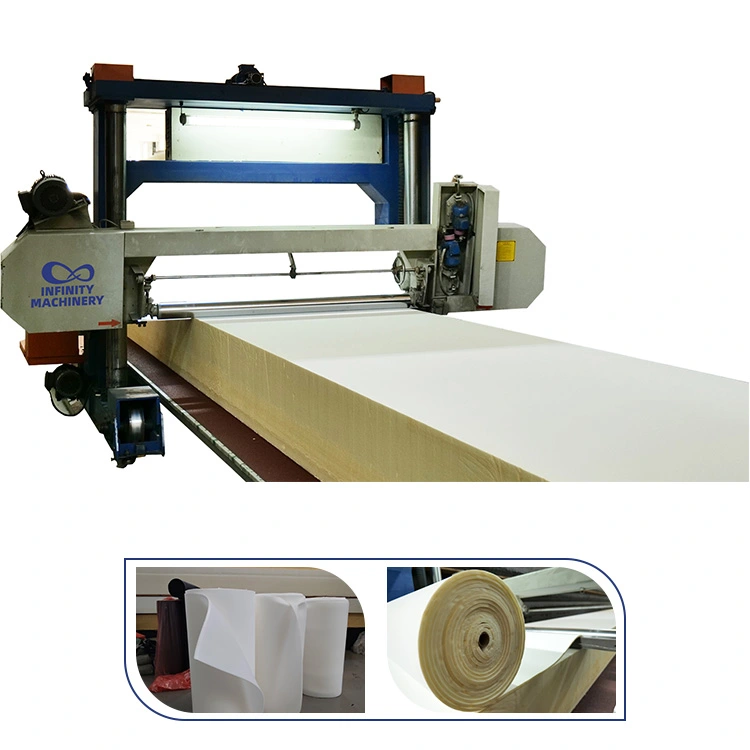
Horizontal blade for sheet production and block splitting. Pairs with IF-CNCV for shape cutting.
Long-track slicing for extended foam blocks. Upstream of the contour cutter for block preparation.
The part is a DXF file. Load it, cut it, ship it. No die engineering, no tooling storage, no 2-week lead time for a new part number.
The continuous blade slices, not melts. The cut surface stays closed-cell — the requirement for medical, acoustic, and automotive applications.
With an 11-minute setup and zero tooling cost, a 12-part prototype run is as profitable per unit as a 12,000-part production run.
Built-in nesting software lifts material utilization from 72% to 91%. For high-density foam at $4.20/kg, that is $0.80 per kilogram of finished part recovered from the scrap bin.
A medical device fabricator in Istanbul was producing custom wheelchair cushions in 14 sizes, each requiring a dedicated die on a hydraulic press. The dies cost $1,800-3,400 each to engineer and manufacture, with a 3-week lead time, and the fabricator held 42 dies in a tooling rack that occupied a quarter of the factory floor. When a hospital requested a custom cushion shape for a pediatric wheelchair — a one-off part for a single patient — the fabricator quoted $2,400 and a 4-week lead time, because the die alone was $2,100. The hospital declined and went to a competitor.
The fabricator then installed an IF-CNCV. On the next custom request — a post-surgical positioning cushion for a specific surgical procedure — the designer drew the profile in CAD in 90 minutes, loaded the DXF onto the machine, and cut the first part in 8 minutes. The fabricator quoted the hospital $340 for the part, with a 3-day lead time, and made a 60% gross margin on it. The 42-die tooling rack was scrapped; the floor space was reallocated to a second IF-CNCV for acoustic panel work. The fabricator's custom-part revenue, which had been 8% of total revenue before the IF-CNCV, reached 31% within 18 months — all on parts that would have been unprofitable to quote on the die-based line.
The fabricator's operations director summarized it this way: "We used to say no to anything under 2,000 units. Now we say yes to anything over one. The machine changed the question from 'can we tool up for this?' to 'do we have the DXF?'"
The IF-CNCV serves a specific class of applications where 2D contour cutting with a clean surface is the deciding requirement. The list below maps the applications where we most often see the machine deployed, ranked by the volume of customer deployments.
Vertical-knife contour cutting is a mature, well-understood technology, but the failure modes that do exist are specific and preventable.
The IF-CNCV ships with nesting software that arranges parts on a block to minimize scrap. Factories that skip it — usually because the operator is comfortable with manual layout — leave 15-20% of material on the table. For a fabricator running 10 tons of foam per month, that is 1.5-2 tons of recoverable material. The nesting software pays for itself in the first month; the question is whether the operator will use it.
Foam densities above 60 kg/m³ resist the blade's lateral pressure and will shift during cutting, producing a contour that drifts from the CAD profile. The optional automatic pressure roller system holds the block in place. Factories cutting rebond foam (80-120 kg/m³) for acoustic and gasketing applications should specify the pressure roller at order time — retrofitting it costs more than the option.
A continuous blade is a consumable. It dulls, it develops micro-cracks, and it eventually breaks. A dull blade produces a rougher cut surface and a wider kerf, which shifts the part dimensionally. The fix is a blade-life tracking schedule — typically 80-120 hours of cutting per blade, depending on foam density — and a replacement before the blade fails, not after. Factories that wait for a blade to break lose a part, lose a block, and sometimes lose a customer's deadline.
The IF-CNCV is not a replacement for a horizontal cutting machine. It is the machine that sits next to one. The horizontal cutter makes the sheets; the vertical-knife contour cutter makes the shapes. Together they cover the full range of foam fabrication — volume sheet production and custom contour work — without overlap and without gap.
For a fabricator serving medical, acoustic, automotive, packaging, or any custom application where the part is defined by a CAD profile, the IF-CNCV is the machine that turns a drawing into a part in under an hour. The 11-minute setup, the ±0.3 mm tolerance, the closed-cell cut surface, and the nesting-driven material savings combine to make small-batch custom work the most profitable segment of the factory — not the loss leader it was on a die-based line.
If your factory is currently declining custom part requests because the die cost makes them unprofitable — or if your tooling rack is occupying a quarter of your floor space — the IF-CNCV is the machine that closes that gap. The payback period, in the case studies we have tracked, is measured in months, not years.
Tell us your foam types, your typical part profiles, and your monthly volume. We will send a line recommendation, a nesting software walkthrough, and a quotation within 24 hours.