Every foam factory generates 8-15% trimming waste as a byproduct of cutting mattress panels to size. Most factories pay to landfill it. The IF-FZS1/2 Re-Bonding Foam Machine turns that waste stream into a revenue stream: it shreds scrap foam, mixes the particles with a polyurethane binder, presses the mix in a hydraulic mold, and steam-cures the block into a dense rebond core that sells for a higher margin than virgin foam. This guide walks through the process engineering, the density control, the integration with the IF-FFS3 foam crushing machine and the IF-FF3 box foaming machine, and the economics that make rebond the most profitable square meter on a foam factory floor.
Rebond foam is not "recycled foam" in the way a consumer might imagine — it is not shredded foam stuffed into a bag. It is a re-engineered material. The process takes clean trim waste from cutting operations, shreds it into 5-15 mm particles, mixes those particles with a moisture-cured polyurethane binder, compresses the mixture in a hydraulic mold to the target density, and steam-cures the block so the binder cross-links the particles into a homogeneous solid. The result is a foam block with a density of 50 to 120 kg/m³ — two to five times denser than typical mattress foam — that has the spring of rubber and the durability of a composite.
That density profile is why rebond foam sells into premium applications, not commodity ones. Carpet underlay, mattress toppers for heavy-use contract environments, gym crash pads, sound-deadening panels in automotive doors, and high-end firm mattress cores all use rebond because it does not take a compression set the way virgin polyurethane does. A contract hotel mattress with a rebond core will hold its firmness for 8-10 years; the same mattress with a virgin HD36 core will start to soften in 4. The hotel buys rebond not because it is cheaper — it is not, per kilogram — but because it lasts longer, and the lifecycle math favors rebond by a wide margin.
The IF-FZS1/2 is the machine that produces those blocks. It is the link between the waste bin and the premium core, and the engineering of that link is what decides whether a factory produces a sellable block or a spongy, delaminating reject.
A rebond line is a sequence, not a single machine. The IF-FZS1/2 is the press and steam-cure station at the heart of it, but understanding the full five-stage flow is what lets a factory engineer hit target density and cure quality on the first block of a run.
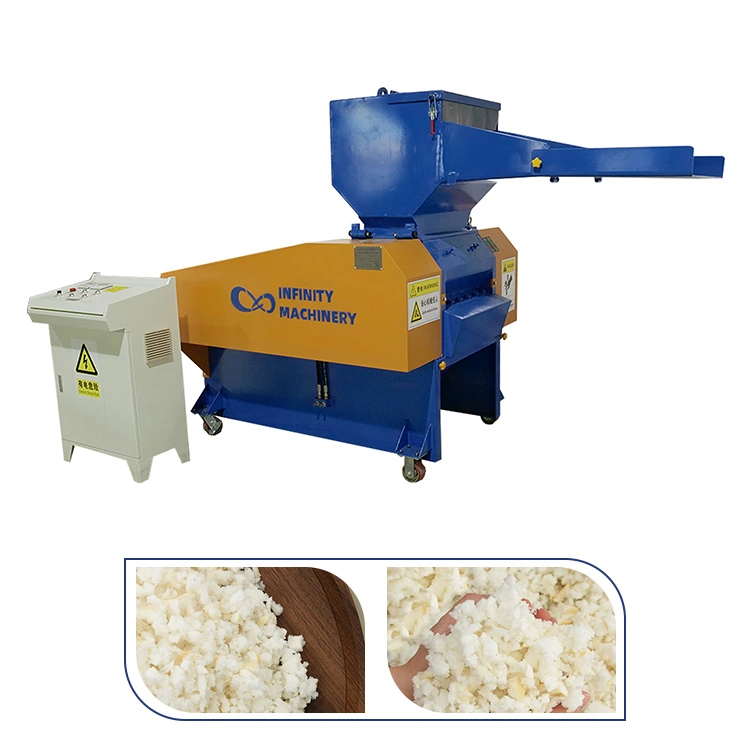
Trim waste — offcuts from the IF-CNCVH CNC foam cutting machine and panel cutting operations — is fed into a shredder that reduces it to 5-15 mm particles. Particle size distribution matters: too fine and the binder ratio has to rise (cost), too coarse and the cured block has visible lumps that fail QA. The IF-FFS3 super-power crusher is the matched shredder for the IF-FZS1/2; it produces a particle distribution that holds the binder ratio stable batch to batch.
The shredded particles are tumbled with a moisture-cured polyurethane binder in a ribbon blender. The binder ratio — typically 8-15% by weight — is the primary density and cost lever. More binder produces a denser, stiffer block but raises raw material cost. The IF-FZS1/2's mixing station is metered, so the operator enters a target density on the HMI and the system doses binder automatically. There is no manual pouring, no bucket-and-guess workflow, and no batch-to-batch drift in the binder ratio.
The binder-coated particles are dropped into a steel mold sized for the target block — typically 2m x 1.5m x 0.1m for a queen mattress core. The hydraulic press descends, compressing the loose fill to the target density. The press holds that pressure while steam is injected through ports in the mold walls. This is the step that distinguishes a rebond press from a simple compactor: the steam heat is what triggers the binder's cross-linking reaction. Without steam, the binder stays tacky and the block never cures. The IF-FZS1/2's "with steam" designation refers to this — the mold is jacketed for live steam injection and the press cycle is timed to the cure kinetics of the binder chemistry.
Steam is injected at 0.2-0.4 MPa for 8-12 minutes, depending on block thickness and target density. The steam carries heat evenly through the block — far more evenly than dry heat would, because the condensation front penetrates the foam matrix uniformly. The cure is complete when the binder has cross-linked through the full block thickness. Undercured blocks delaminate under load; overcured blocks become brittle. The IF-FZS1/2's HMI stores cure profiles per density target, so an operator running a 80 kg/m³ carpet underlay block on Monday and a 110 kg/m³ mattress core on Tuesday does not have to re-develop the cure curve each time.
The press opens, the block is pushed out of the mold, and it goes to an aging rack for 24-48 hours. During aging, the binder completes its secondary cross-linking with ambient humidity and the block reaches its final mechanical properties. A block cut too soon after demold will have surface tears; a block aged the full 48 hours will slice cleanly on the IF-FYP6/7/10 carrousel splitting foam cutting machine and hold dimensional tolerance.
A rebond line lives or dies on density control. Sell rebond as a carpet underlay at 60 kg/m³ when the spec calls for 70 kg/m³ and the customer rejects the shipment. Sell it at 80 kg/m³ when the spec calls for 70 and the factory has given away 14% of its material margin. Density is controlled by three variables, and the IF-FZS1/2 automates all three.
The practical effect is that a factory running the IF-FZS1/2 can hit a target density of 80 kg/m³ with a tolerance band of ±2 kg/m³ across a 100-block run. On a mechanically controlled press — the kind that uses a pressure gauge and a stopwatch — that same tolerance band is ±8 kg/m³, which is the difference between a sellable block and a reject. The metered dosing alone pays for the upgrade in binder savings within the first quarter of production.
The margin math on rebond is what surprises factory owners who have only run virgin foam lines. Virgin foam is priced as a commodity — the raw chemicals (polyol, isocyanate, catalysts, blowing agents) are 70-80% of the cost of a finished block, and the factory margin is squeezed by chemical suppliers. Rebond inverts that ratio. The primary input — trim waste — has zero raw material cost because the factory has already paid for it as part of the virgin foam production. The only purchased inputs are the binder (8-15% of block weight) and the steam (a factory utility).
There is a second margin lever that does not show up in the per-kilogram cost. A factory that installs a rebond line can quote a "closed-loop" or "zero-waste" sustainability story to its brand customers, and in 2026 that story carries a price. European mattress brands operating under Extended Producer Responsibility regulations will pay a 6-12% premium for a mattress core documented as containing factory-recycled content. The IF-FZS1/2 produces the block; the block carries the documentation; the documentation carries the premium. Factories that have added rebond lines in the last 24 months report that the sustainability premium alone, not the raw material savings, was the deciding factor in the investment.
The IF-FZS1/2 is the heart of the line, but a rebond cell typically combines four stations. Infinity Mattress Machinery builds all of them, which means the line is engineered to integrate rather than assembled from incompatible vendors — the shredder produces the particle size the press expects, the press produces the block size the splitter expects, and the control systems share a common HMI architecture.
Super-power shredder that reduces trim waste to 5-15 mm particles with a controlled size distribution.
Hydraulic press with steam cure, metered binder dosing, recipe-stored density profiles.
Carrousel splitting machine that slices the cured rebond block to the final mattress core thickness.
The 8-15% trim waste that a factory currently pays to landfill becomes a sellable block. The waste disposal line item in the P&L flips to a revenue line.
Closed-loop hydraulic servo and metered binder dosing hold the density tolerance to ±2 kg/m³. No more reject blocks shipped because the press operator guessed the binder pour.
European EPR-regulated brands pay a 6-12% premium for documented recycled content. The IF-FZS1/2 produces the block; the documentation carries the premium.
Cure profiles, binder ratios, and press pressures are stored per density target. Switching from a 60 kg/m³ underlay to a 110 kg/m³ mattress core is a recipe load, not a setup day.
A mid-size foam factory in Cairo producing 220 tons of virgin foam per month was generating 24 tons of trim waste — about 11% of output — and paying a waste hauler $4,800 per month to landfill it. The factory's cost accountant had categorized that $57,600 per year as a fixed overhead and nobody had questioned it for five years. When the factory owner toured a sister plant that had installed an IF-FZS1/2, the question that came back to Cairo was: "Why are we paying to throw away the most profitable material we produce?"
The factory installed an IF-FZS1/2 paired with an IF-FFS3 crusher. In the first month of production, the line converted 22 of the 24 tons of trim waste into 1,870 rebond blocks at 80 kg/m³. Those blocks sold to a carpet underlay distributor at $4.40 per kilogram, generating $77,400 in revenue from material the factory had previously paid to dispose of. The waste hauling contract was canceled. The binder cost for the month was $11,200; the steam cost was $900. The gross margin contribution of the rebond line in its first full month was $65,300 — and the machine had cost $148,000 installed.
The factory owner's comment to his operations team, three months after installation, is the one we hear most often from rebond customers: "We thought we were buying a recycling machine. We were actually buying a second profit center."
Rebond is a forgiving process compared to virgin foaming — there is no exothermic reaction to run away, no blowing agent balance to hold — but the failure modes that do exist are specific and preventable.
If the shredder screen is worn or the wrong mesh is installed, the particle distribution shifts and the binder ratio that was correct yesterday is suddenly wrong today. The symptom is blocks that cure too soft or too hard for no obvious reason. The fix is a crusher maintenance schedule — inspect the screen weekly, replace it before it wears through — and a one-time validation of the particle distribution when the crusher is commissioned.
The cure is timed to the steam pressure. If the factory steam header drops pressure when another machine draws load, the cure curve shifts and the block undercures. The IF-FZS1/2's HMI monitors steam pressure and will hold the press closed until the pressure recovers, but the cleaner fix is a dedicated steam accumulator for the rebond line. Factories that skip the accumulator spend the first two months chasing intermittent undercure before installing one.
A freshly demolded block looks cured — it holds its shape, it feels firm — but the binder's secondary cross-linking with ambient humidity is not complete for 24-48 hours. Cutting the block early produces surface tears and dimensional drift. The fix is a discipline issue, not an engineering one: the aging rack has to hold the block for the full aging window, and the cutting schedule has to respect it.
The IF-FZS1/2 is not a replacement for a virgin foaming machine. It is the machine that sits next to one, converting the trim waste the virgin line generates into a sellable product at a margin the virgin line cannot match. Every factory producing more than 100 tons of virgin foam per month is generating enough trim waste to justify a rebond line on volume alone; the sustainability premium that European and North American brand customers now pay for documented recycled content makes the case overwhelming.
The IF-FZS1/2 brings the engineering that makes rebond reliable — metered binder dosing, closed-loop press pressure, steam-cured cross-linking, recipe-stored density profiles. Pair it with the IF-FFS3 crusher for shredding, the IF-FYP6 splitter for slicing, and the IF-FF4 or IF-FF3 for virgin foam production, and the result is a closed-loop foam cell that converts 90%+ of chemical input into sellable product. The waste hauler's invoice becomes a memory; the sustainability documentation becomes a sales argument; and the trim waste bin becomes the most profitable feedstock on the factory floor.
If your factory is currently landfilling trim waste — or selling it to a third-party rebond producer at commodity pricing — the IF-FZS1/2 is the machine that captures that margin for your own P&L. The payback period, in the case studies we have tracked, is measured in months, not years.
Tell us your monthly foam output, your trim waste volume, and your target rebond density. We will send a line recommendation, a binder consumption estimate, and a quotation within 24 hours.