When I opened my mattress-ticking workshop six years ago, I thought the hard part would be finding customers. It wasn’t. The hard part was quilting fast enough to ship what I had already sold. My first “production line” was two operators guiding fabric under a single-needle quilting machine by hand. On a good day we quilted 60 square meters. On a bad day — a skipped stitch, a puckered seam, a pattern that drifted half an inch — we threw half of it in the scrap bin.
Everything changed the day we installed the IF-Q-1200 Computerized Chain Stitch Multi-Needle Quilting Machine. This is the machine that took us from 60 m² a day to more than 1,200 m² a day, cut our defect rate from double digits to under 1%, and let us finally say yes to the big bedding and mattress orders we used to turn away.
When you quilt mattresses and bedsheets by hand, the machine is not really the bottleneck — your hands are. Two operators would stand at a single-needle machine, feed the ticking and batting, steer the fabric to follow a pattern, and hope the stitch line stayed straight. It didn’t always. A full queen-size mattress panel took the better part of an hour. A bedsheet set took twenty minutes. Multiply that across a daily order book of a few hundred panels and you quickly run out of daylight.
The quality problem was worse than the speed problem. Hand steering drifts. Patterns that looked perfect on the first panel looked crooked by the tenth. Hotels and mattress brands that bought from us started sending back rolls with “uneven quilting” written on the invoice. Our scrap rate sat at 10–14%. Every rejected roll was fabric, thread, labor, and a dent in a relationship we could not afford to lose.
The breaking point was a tender from a regional bedding chain. They wanted 8,000 quilted bedsheet sets in six weeks. At 60 m² a day, we would have needed four months. We lost the tender. That same week, I started researching computerized quilting machines in earnest, and that search led me to the IF-Q-1200.
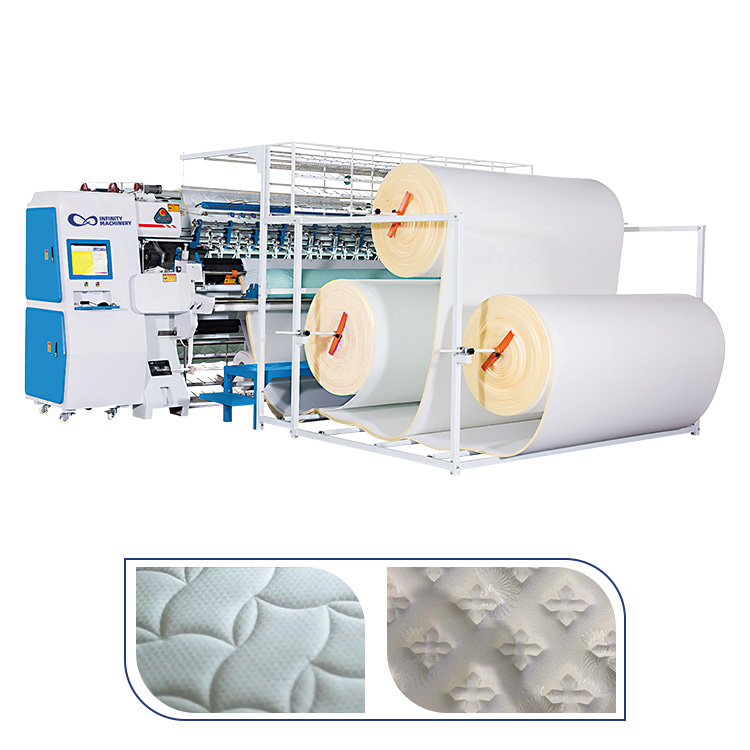
The IF-Q-1200 is a computerized chain stitch multi-needle quilting machine. In plain language: it has a row of needles working together across the full width of the fabric, a servo-driven carriage that moves the material with computer precision, and a pattern system that lets you switch designs with a few taps instead of re-threading or re-jigging anything. It is the workhorse behind most mid-size mattress-ticking and bedding quilting operations I know.
What sold me was not any single spec — it was the combination. A machine can be fast and sloppy, or accurate and slow. The IF-Q-1200 is the first quilting machine I saw that was both, and that is exactly what a bedding and mattress workshop needs to stay competitive on price while keeping quality complaints near zero.

Installation took the better part of a week. Infinity sent the layout drawing, we poured the foundation and set the machine, and a technician walked us through calibration and the first pattern load. By day three we were quilting real orders. By the end of the first week we had already beaten our old monthly output.
The numbers were not subtle. Here is the comparison that convinced our accountant:
Within two months we went back to the bedding chain that had rejected us and quoted the same 8,000-set tender — this time with a two-week delivery promise. We won it. The IF-Q-1200 paid for itself in just over seven months, and that is before counting the scrap we stopped throwing away.
The two common quilting technologies are chain stitch and lock stitch. The IF-Q-1200 is a chain stitch machine. Our sister line, the IF-QM1-4 Automatic Lock Stitch Quilting Machine, uses lock stitch. Both have their place, and knowing the difference saves you from buying the wrong machine.
If your core business is mattress panels and everyday bedding, chain stitch is the pragmatic choice — it handles thicker stacks, runs faster at volume, and costs less per square meter. If you are selling high-end decorative quilts where every stitch is on display, look at the lock stitch IF-QM1-4. Many of our customers run one of each.

A multi-needle machine like the IF-Q-1200 quilts a whole row at once. A single-needle machine like the IF-QS2-1 Automatic Computerized Single Needle Quilting Machine traces one line at a time. The single-needle is slower, but it shines for custom, low-volume, and oddly shaped panels — samples, prototypes, and the one-off order a big machine is awkward for.
We kept a single-needle machine alongside the IF-Q-1200 for exactly that reason. Production volume goes to the multi-needle; custom and sampling go to the single-needle. If you are just starting and your order book is thin, a single-needle machine may be enough. Once you cross roughly 300 m² a day of steady demand, the multi-needle IF-Q-1200 pulls decisively ahead on unit cost.
Exact figures vary by configuration and material, so treat the table as the typical working range rather than a fixed spec sheet. When you talk to Infinity, give them your widest panel and thickest stack and they will confirm the right build for you.
If you have never installed an industrial quilting machine, here is the real sequence we went through, so you can plan your own shop:
Total time from delivery to full production was under two weeks for us. The longest part was the concrete, not the machine.

The IF-Q-1200 is not a one-trick machine. In our workshop it runs:
Because one machine covers all of these, a small workshop can take on mattress, bedding, and home-textile orders without buying separate equipment for each. That flexibility is what let us grow from a ticking shop into a general bedding supplier.

We have run the IF-Q-1200 for 18 months. Here is the honest maintenance picture:
The biggest maintenance lever is needle hygiene. A clean needle row is the difference between a 0.8% defect rate and a 5% one. We built it into the shift-end routine and have not had a quality complaint in over a year.
Not every workshop needs the IF-Q-1200. Here is the decision guide I give friends who ask:
If you are unsure, send Infinity your typical panel size, daily volume, and material list. They will size the machine instead of upselling you.
Can the IF-Q-1200 quilt thick mattress batting?
Yes. Chain stitch handles thick layered stacks — ticking, foam, and batting — better than lock stitch at volume, which is why it is the standard for mattress production.
How long does it take to switch patterns?
About 15 minutes of setup — load the digital pattern, thread the row, and run a test strip. No half-day rethreading like a manual machine.
Is it difficult to operate for a new team?
The interface is touchscreen and pattern-driven. We trained one operator in two days. Most of the work is loading rolls and watching the line, not steering fabric.
What is the real defect rate after break-in?
Ours settled at about 0.8% once the team learned needle hygiene and tension. That is a fraction of the 10–14% we had by hand.
Can it handle bedsheets, not just mattresses?
Yes. We run bedsheet sets, duvet covers, and comforters on the same machine. One machine covers your whole bedding line.
How soon does it pay back?
For us, the savings from labor and scrap recovered the machine in just over seven months. Your number depends on volume and labor cost, but the math is compelling at scale.
The IF-Q-1200 Computerized Chain Stitch Multi-Needle Quilting Machine is the machine that turned our workshop from a scrap-generating bottleneck into a bedding supplier that says yes to big orders. It is fast, accurate, and forgiving enough for a small team to run. If your quilting demand is past the few-hundred-square-meter mark, it is the obvious next step.
Infinity Mattress Machinery has built quilting and mattress production equipment for over a decade. Their machines are CE certified and ISO 9001 compliant, and the support we received — from layout drawing to technician visit — is the reason we kept expanding with them. If you are weighing a quilting machine, talk to them about the IF-Q-1200, the IF-QM1-4 lock stitch, the IF-Q-1400 wider model, and the IF-QS2-1 single-needle, and they will size the right line for your shop.
Tell us your panel size, daily volume, and materials. We will recommend the right quilting machine — IF-Q-1200, IF-QM1-4, IF-Q-1400, or IF-QS2-1 — and calculate your payback.


