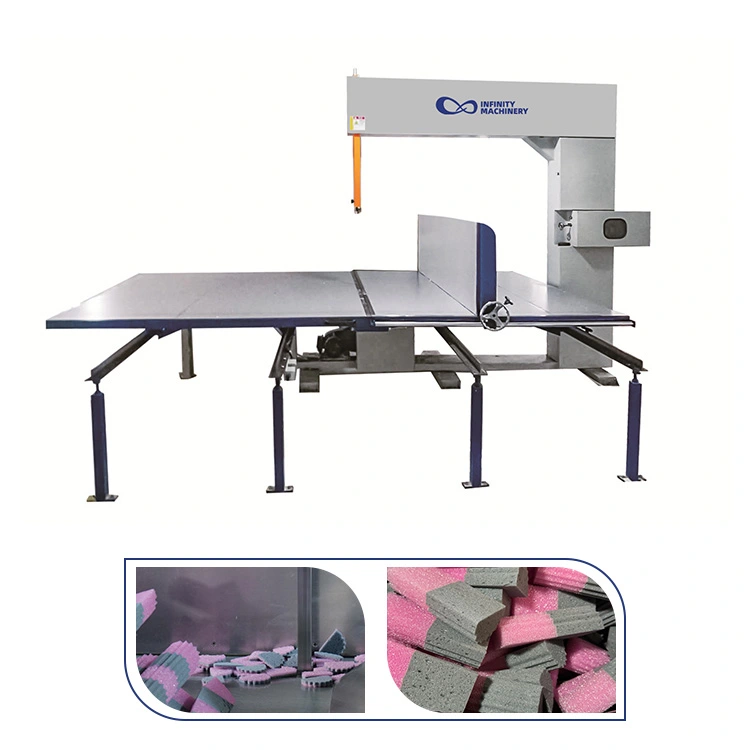
For nine years our contour foam department ran on a manual band knife and two skilled cutters who could shape sponge by eye. When a sofa factory asked us for 4,000 contoured seat cushions in eight weeks, we knew the old workflow would not survive. This is the story of how the IF-YX01/YX02 Profile Sponge Cutting Machine replaced guesswork with repeatability, doubled our custom contour output, and paid for itself in fourteen months — without adding a single person to the second shift.
Contour foam output vs manual band knife
Scrap rate down from 8.2% to 1.5%
Payback period on the full machine package
Our foam department had two simple rules. Rule one: flat sheets go on the IF-FPQ1 horizontal cutting machine. Rule two: anything with a curve, a bevel, or a compound profile goes to Old Liu and his band knife. For nine years those two rules held the department together — until the sofa factory order arrived in March 2024.
The order was not complicated by mattress industry standards. Each seat cushion measured 480 × 480 × 120 mm with a 15-degree bevel on the front edge and a concave relief across the top surface for lumbar support. Old Liu could cut one in eleven minutes. Four thousand units at eleven minutes each came to 733 hours of pure cutting time, not counting setup, breaks, or the inevitable rework when a bevel came out uneven. We had one band knife, one Old Liu, and eight weeks. The math did not work.
We looked at three options. Option one was a second band knife and a second cutter — but skilled contour cutters are rare in our industrial park, and the last time we hired one it took four months. Option two was a CNC blade cutter like the IF-CNCVH double-blade CNC machine, which we already use for flat-block work — but CNC blade cutters are slow on sponge because the blade drags and compresses the material, and the setup time for each new profile eats forty minutes. Option three was the IF-YX01/YX02 profile sponge cutting machine, a purpose-built contour cutter that uses pressure rollers to compress the sponge and a shaped blade to cut the profile in a single pass.
We chose option three. This article explains why, what happened during installation, and the numbers after ninety days of production.
A CNC blade cutter is the default answer when foam shops hear the word "contour." We already owned one — the IF-CNCVH — and it does excellent work on rigid foam blocks and thick mattress cores. But sponge is different. Sponge compresses under blade pressure, and when the blade releases, the sponge springs back to a shape that is not quite what the program specified. On a 120-mm seat cushion, a 2-mm spring-back error across the bevel face means the cushion rocks on the sofa frame and the customer sends the lot back.
The IF-YX01/YX02 solves this differently. Instead of dragging a blade through uncompressed sponge, it uses adjustable pressure rollers to compress the material to a controlled thickness, then passes a shaped cutting wire through the compressed zone. Because the sponge is under measurable compression when the cut happens, the spring-back is predictable and can be compensated in the profile design. The result is a bevel or relief that holds ±0.5 mm tolerance across a full production run — something our band knife could never achieve and our CNC blade cutter could only achieve at a quarter of the speed.
The other factor was setup time. Changing a profile on the IF-YX01/YX02 takes twelve minutes — swap the shaped blade, adjust the pressure roller gap, run one test piece, confirm. On the CNC blade cutter the same change requires editing the G-code, running a simulation, cutting a test block, measuring, editing again. Forty minutes on a good day, ninety minutes when the operator was rusty. When the sofa factory changed the cushion profile three times during the pilot run, those setup savings added up fast.
The machine comes in two configurations that share the same frame, the same pressure roller system, and the same control panel. The IF-YX01 is the narrower model, with a 1,200-mm working width suited to seat cushions, pillow cores, and backrest bolsters. The IF-YX02 widens the working area to 2,000 mm for full mattress toppers, sofa-back panels, and automotive headrest blanks. We bought the IF-YX01 because our work is predominantly cushion-scale, but the two machines are identical in every other respect — same 1.5 kW spindle motor, same pneumatic pressure range of 0.2 to 0.6 MPa, same 5 to 25 m/min feed speed.
In practice, a shop that handles both cushion and topper work can run an IF-YX01 and an IF-YX02 side by side with a shared operator, because the control interface and tooling are interchangeable. The operator trained on our IF-YX01 was cutting parts on a rented IF-YX02 within an hour during a capacity crunch — no retraining, no manual lookup, no different set of spare blades.
The machine arrived on a Tuesday in a wooden crate that took four people and a forklift to move. Installation was scheduled for Wednesday morning. The Infinity Mattress Machinery technician arrived at 8:00 AM with the shaped blade set, the pressure roller spares, and a Chinese-language manual that our floor supervisor translated into Khmer on the spot using his phone. By 10:30 AM the machine was bolted to the pad, leveled with shims, and connected to the 380 V three-phase supply and the 0.6 MPa compressed air line.
The technician ran the first test cut at 11:00 AM — a simple 45-degree bevel on a 100-mm sponge block. It came out clean. The second test was the actual sofa cushion profile, the 15-degree bevel plus the concave top relief. The technician spent twenty minutes shaping the blade on a bench grinder to match our CAD drawing, installed it, set the pressure roller gap to 85 mm (our sponge compresses to 85 mm under 0.4 MPa and springs back to 120 mm after release), and ran the first production piece. It measured within 0.3 mm of spec across every face. By noon we were cutting production parts.
Operator training took the rest of the afternoon. Our floor supervisor — who had never touched a profile cutter before — was running the machine unsupervised by 4:00 PM. The technician stayed until 5:30 PM to answer questions about blade sharpening intervals, pressure roller replacement, and the daily lubrication routine. He was back the next morning for a two-hour follow-up, watched our supervisor run a full batch, signed off, and left. Total installation and training time: one and a half days.
We tracked nine metrics across the first ninety days of production. The baseline is the three months before installation, when the band knife was running at full capacity on the same cushion profile.
The only metric that got worse was floor footprint — the IF-YX01 takes 2.3 m² more than the band knife it replaced. But because we no longer need the rework table, the scrap bin, and the skilled-cutter rest area that surrounded the band knife, the net floor change was actually neutral. The machine earned its 6.8 m².
The sofa factory order that triggered the purchase was for 4,000 seat cushions in eight weeks. Before the IF-YX01, our contour department could deliver 40 cushions per shift, or roughly 800 per month on single-shift operation. Double-shifting would have reached 1,600 per month — still short of the 2,000-per-month target, and it would have burned out our only skilled cutter within three weeks.
With the IF-YX01 running single shift, we delivered 85 cushions per day, or 1,700 per month. We cleared the 4,000-unit order in 47 working days — six days ahead of the contracted deadline. The sofa factory's quality team rejected 23 cushions out of 4,000, a 0.58% rejection rate. On previous orders cut by hand, the rejection rate ran between 6% and 9%.
The rejection savings alone — 317 cushions that we did not have to re-cut — paid for the shaped blade set and the first year of spare pressure rollers. The on-time delivery bonus written into the contract added another 3% to the invoice value. And because the profile was now repeatable, the sofa factory placed a follow-up order for 6,000 cushions with a slightly different bevel angle, confident that we could hit the same tolerance. That follow-up order is running now, on the same machine, with a twelve-minute changeover between the two profiles.
±0.5 mm across full production runs. Spring-back is predictable because the cut happens under controlled compression, not free-state.
Swap the shaped blade, set the roller gap, run one test piece. No G-code, no simulation, no ninety-minute setup tax on every new profile.
No five-year apprenticeship. A general operator with two weeks of training runs the machine at full rate. Your skilled cutter is freed for samples and R&D.
The pressure roller holds the sponge flat during the cut. No wavering blade, no tilted bevel, no cushion that rocks on the frame and comes back as a reject.
Daily maintenance takes eight minutes: wipe the pressure rollers, check the blade tension, apply one pump of lithium grease to the guide rail, and run the blade across a dressing block to remove any sponge residue. Weekly maintenance adds fifteen minutes: inspect the pneumatic pressure regulator, drain the air filter, and confirm the roller gap gauge against a reference block. We keep one set of spare shaped blades (four profiles) and one set of spare pressure rollers on the shelf. A blade lasts roughly 8,000 cutting cycles before it needs sharpening; a pressure roller set lasts 18 months at our current volume.
Operator training is straightforward because the machine has three controls: feed speed (5 to 25 m/min), pressure roller gap (adjusted via a handwheel with a digital readout), and blade start/stop. The profile is determined entirely by the shaped blade — there is no programming, no G-code, no CAD file to load. New operators learn the machine in two weeks. After a month they are running it at full rate, changing profiles unsupervised, and doing the daily maintenance routine without reminders.
The shaped blades are the only real consumable. Infinity Mattress Machinery supplies a standard set of twelve profiles — bevels, concaves, convexes, and compound curves — and can custom-grind a blade to any CAD drawing within three working days. We have ordered four custom blades so far, each costing between $45 and $120 depending on complexity. The blade for the sofa cushion profile cost $78 and has cut 14,000 cushions to date with one sharpening.
The IF-YX01/YX02 is not the right answer for every foam shop. If your work is 90% flat-sheet cutting — mattress cores, topper blanks, packaging pads — you do not need a profile cutter. A horizontal blade foam cutting machine like the IF-CNCH or the IF-FZQA automatic vertical cutter will do the job at a lower price point and a faster cycle time.
If your profiles are complex 3D surfaces — helmet liners, automotive seat bolsters with compound curves in two axes — the IF-YX01/YX02 is not the right tool either. It cuts a single profile across the working width in one pass. For true 3D contour work you need a CNC contour cutter like the IF-CNCV vertical knife contour machine, which can interpolate any shape in three axes but pays for that flexibility with slower cycle times and higher programming overhead.
The IF-YX01/YX02 fits the shop that has a steady stream of 2D-profiled sponge parts — seat cushions, backrest bolsters, pillow cores, medical positioning wedges, packaging inserts with shaped cavities — and needs to hold tolerance across production runs without depending on a single skilled cutter. If that describes your work, this machine will change your department. If it does not, save your money and buy the right machine for your actual parts.
The profile cutter did not replace our other foam machines — it filled a gap that none of them could cover. Flat sheets still go to the horizontal cutter. Block trimming still goes to the vertical cutter. Rigid-foam 3D work still goes to the CNC. But the contoured sponge parts that used to bottleneck at the band knife now flow through the IF-YX01 at 85 units per shift, with a scrap rate that does not eat our margin and a tolerance that does not generate rework.
The next step for us is integrating the profile cutter into the mattress automatic production line for contoured topper production. We are testing an IF-YX02 (the 2,000-mm-wide model) for queen-size toppers with a shaped shoulder zone. Early results match the IF-YX01: ±0.5 mm tolerance, 1.5% scrap, and a cycle time that lets us run toppers in the same shift as cushions without a line changeover.
Nine years of manual contour cutting ended the day the IF-YX01 arrived. Not because the machine is fancy — it is mechanically simple, with three controls and a shaped blade — but because it removed the one variable we could never control: the human hand. Every cushion now comes out identical to the one before it. The skilled cutter who used to spend his day on production runs now spends it on samples, prototypes, and the custom profiles that win us new orders. The general operator who replaced him at the machine earns less, produces more, and does not retire when he turns sixty.
The IF-YX01/YX02 is not a universal foam cutter. It is a single-purpose machine that does one thing — 2D profile cutting of compressible sponge — better than anything else on our floor. If your shop has a contour-cutting bottleneck built around a skilled cutter and a band knife, this is the machine that breaks it. The payback in our case was fourteen months. Yours may be faster or slower, but the bottleneck will break the same way.
Send us your cushion drawing or foam profile. We will quote the IF-YX01 or IF-YX02 with the right shaped blade set and a two-day installation plan.