Twelve of every 200 mattresses we shipped arrived damaged. That is 6% — and at roughly $180 landed cost per mattress, it was about $2,160 a week walking out the door in torn foam and crushed edges. We did not have a shipping problem. We had a packing problem.
We run a family-owned mattress factory in Guadalajara. For years we sold locally and did fine. Then we started exporting — first to the border region, then to Central America. The orders got bigger, and so did the complaints.
Customers sent photos: edges crushed flat, ticking covers split open, pocket springs poking through the side. At first we blamed the carriers. We changed freight forwarders twice. The damage did not change.
So we counted. Over one month of shipping 200 mattresses a week, 48 arrived damaged — exactly 12 per week, every week, like clockwork. Some weeks worse. That was when we stopped blaming the truck and started looking at the mattress itself.
Here is what nobody tells you when you start exporting: a flat, bare mattress is one of the most fragile things you can put in a container. It has no rigid shape. In a 40-foot box, mattresses get stacked three and four high, then a pallet of ceramics or an engine block gets loaded on top. The bottom mattress takes the whole load.
Vibration does the rest. A container rolls for two weeks across a border or an ocean. Every bump flexes the foam. The corners — the weakest part of any mattress — take the hit first. Add humidity at the port, dust, and a forklift driver who is having a bad day, and you get exactly the failure pattern we saw: edges crushed, covers torn, springs exposed.
Wrapping a flat mattress in stretch film does almost nothing. Film holds the shape you give it; it does not create a shape. A flat mattress wrapped in film is still a flat mattress that can be crushed. The only way to make a mattress survive transit is to change its shape — make it small, dense, and round, so there is nothing left to crush.
That is the whole insight. Three actions, in order: compress the mattress so its volume collapses, roll it so it becomes a tight cylinder, then wrap that cylinder in protective film. Do those three things and the mattress stops being fragile.
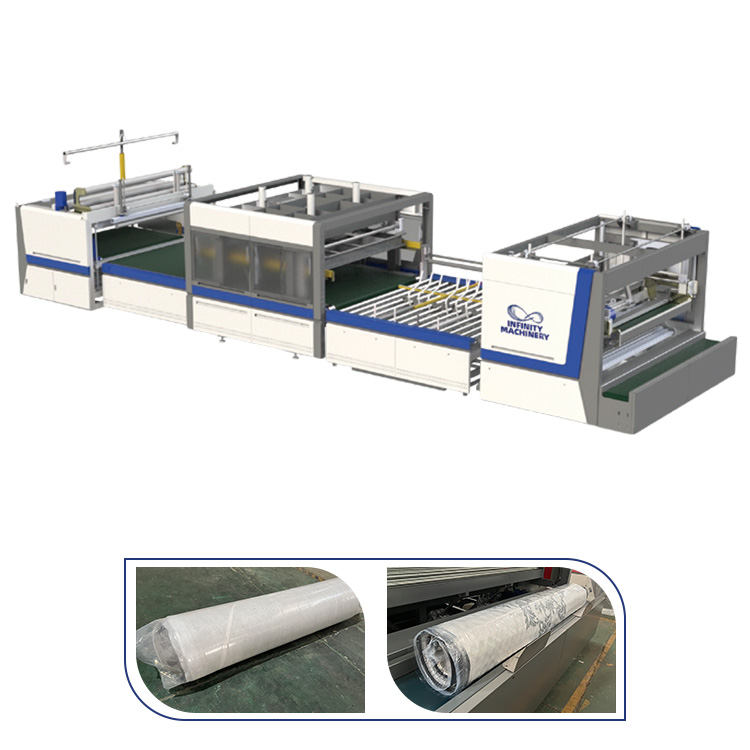
We did it with two machines from Infinity Mattress Machinery: the IF-CR2 roll packing machine (which compresses and rolls) and the IF-MR roll wrapping machine (which films the finished roll). Neither is the biggest machine they make. Together they were exactly the right size for a 200-a-week operation.
The IF-CR2 is an intelligent roll packing machine built around a Siemens PLC controller. You feed a mattress in one end; it automatically detects the size, sets the compression and folding parameters, and pushes the mattress through a compression chamber and onto a roller. About 30 seconds later a tight roll comes out the other end.
Because the PLC controls the parameters, every mattress gets packed the same way — no variation between operators, no variation between the Monday shift and the Saturday shift. That consistency matters more than it sounds: a mattress compressed to 60% of its volume behaves predictably in a container, and predictable is safe.
It handles foam, latex, and pocket spring mattresses without changeover drama. We run all three. One machine packs 200 to 400 mattresses per shift with two or three operators. For a factory our size that was the difference between packing being the bottleneck and packing being a non-event.
Most importantly for our problem: once a mattress is compressed and rolled, there is almost nothing left to crush. The load above it in the container now rests on a dense cylinder, not on a soft edge. That single change is what took our damage rate off a cliff.
The IF-MR is the entry-level roll wrapping machine, and it does one job extremely well: it automatically wraps the compressed roll in a tight layer of protective film. If the IF-CR2 makes the mattress safe to stack, the IF-MR makes it safe to handle.
Film applied by hand is loose and tears at the first snag. The IF-MR applies it under tension, so the wrap hugs the roll and stays put through loading, unloading, and the inevitable scrape against a container wall. It seals out humidity and dust, and it gives the roll a smooth surface that slides instead of catching.
We chose the IF-MR specifically because we were not ready to buy a fully automatic line. It handles 50 to 200 rolls a day, sits right at the exit of the IF-CR2, and cost a fraction of the bigger machines. It was the lowest-risk way to close the last gap in our packing process. As volume grows we can add an IF-AMB later without throwing anything away.
On our floor the line is simple. A finished mattress comes off the production line and goes into the IF-CR2. Thirty seconds later a compressed roll drops onto a short roller table. An operator nudges it into the IF-MR, which wraps it in film in a few seconds. The wrapped roll goes straight onto a pallet.
Because the roll is small and uniform, pallets stack tight — we fit roughly three times the mattresses in the same floor space we used for flat stacking. The pallet goes into the container already stable. There is no soft pile to shift during transit, no corners sticking out to get caught by a forklift.
Throughput is 200 to 400 mattresses per shift with two or three people, and the work is light. Nobody is wrestling a queen mattress anymore. The physical strain on the packing crew dropped as much as the damage rate did — a benefit we did not expect and now would not give up.
We tracked the first six months after installation. The difference was not subtle.
The freight number moved because compressed rolls take roughly 60% less volume — same shipment, fewer containers. The damage number moved because there was nothing left to crush. Add the labor savings and the freed warehouse space, and the two machines were saving us well over $2,000 a week.
At that rate the combined cost of the IF-CR2 and IF-MR was recovered in about five months. Everything after that was straight margin. The six months we had spent debating whether we could afford the machines turned out to be the most expensive part of the whole project.
The damage rate is the number we cared about most, because it was the number our customers felt. Going from 12 broken mattresses a week to under one changed everything downstream.
Chargebacks from distributors dropped to nearly zero. Our review scores on the export market climbed because customers stopped receiving compromised product. The few damaged units we still see are almost always from a carrier dropping a pallet, not from the packing — and even those are rare now that the rolls are stable.
There is a second effect nobody puts on a spreadsheet. When your product arrives intact, your distributor trusts you. Ours started giving us larger, steadier orders because they knew what would show up. That relationship, built on reliability, is worth more over a year than the freight savings alone.
Inventory efficiency. Compressed rolls take about 60% less warehouse space. We converted part of our finished-goods area into a second quilting station because the rolls stacked so much tighter. Same building, more production.
Customer perception. A professionally compressed and film-wrapped mattress in clean packaging arrives with a premium feel. End customers read the roll-pack experience as quality. Distributors prefer suppliers who deliver roll-packed product because it is easier to handle and store — and that preference shows up as repeat orders.
New business. With damage under control and freight lower, we could price more competitively and still protect margin. That let us win a contract into the US market we had previously written off as impossible. The machine did not just fix a problem; it opened a door.
"I spent six months asking whether we could afford a packing machine," our plant manager said. "What I should have asked was whether we could afford not to have one. We were shipping $2,000 a week into the trash in broken mattresses, and the fix cost less than one bad quarter."
Six months after install, the damage line on our report is basically a rounding error. The IF-CR2 and IF-MR paid for themselves and then became invisible — which is exactly what good equipment should do.
Siemens PLC control. Auto size detection. 30s per roll. Foam, latex, pocket spring. 200-400/shift.
View IF-CR2
Automatic roll wrapping. 50-200 rolls/day. Entry-level investment, professional protection.
View IF-MRIF-CR2 — You are producing 100 to 500 mattresses a day and exporting, or want to start. You need a reliable, intelligent machine that handles multiple mattress types and packs them identically every time. This is the workhorse most exporters should buy.
IF-MR — You are at lower volume, or you already compress and only need the wrapping step done right. It gets you professional roll protection at the lowest entry cost, and it pairs perfectly with the IF-CR2 as your volume grows.
Together — If transit damage is your problem, the combination is the answer. Compress and roll with the IF-CR2, wrap and protect with the IF-MR, and the mattress that leaves your dock is the mattress that arrives at your customer's door.
A packing machine is not an expense for an exporter. It is the difference between a mattress that survives the journey and one that does not. For us, the IF-CR2 and IF-MR took transit damage from a weekly fire drill to a non-event, freed warehouse space, lowered freight, and helped us win a market we had given up on.
If you are shipping mattresses and seeing damage, send your numbers to Infinity's team. Tell them your weekly volume, your average container cost, and what you pack now. They will calculate your ROI in a day — and you may find, as we did, that the machine pays for itself faster than the problem is costing you.
Send us your monthly export volume and container costs. We'll calculate your ROI in one business day. No obligation, no sales pitch.

