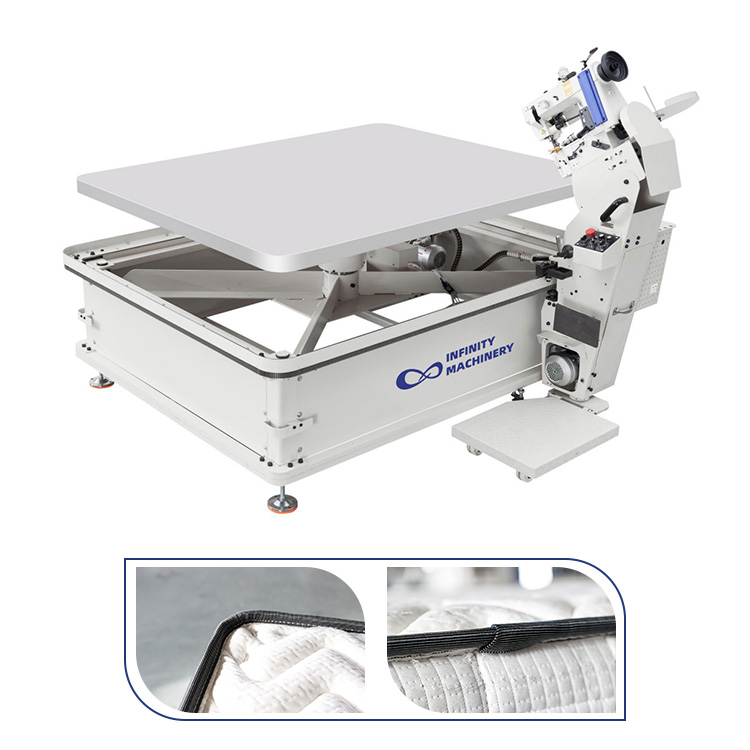
A high-volume mattress factory runs 200 to 400 units per day, and the tape edge machine is the throughput gate of the finishing line: the machine that cannot keep up forces a second shift, an extra crew or a bottleneck that idles the packing station. The value question is not which machine is cheapest, it is which machine delivers the lowest total cost per unit at the target volume. The IF-T5 Automatic High Speed Mattress Tape Edge Machine leads the high-volume comparison, with the IF-T3T Chain Stitch as the value mid-range. This guide compares the machines on throughput, labor, cost per unit and payback, and names the best value for each volume band.
The tape edge value decision is a cost-per-unit decision, and the machine price is only the first number. The cost per unit has three parts: the machine cost spread over its output, the labor cost per unit and the rework and downtime cost. A cheaper machine that runs slower, needs more operators or breaks down more often has a higher cost per unit than a more expensive machine that runs the volume with one operator. The value comparison measures all three parts at the factory target volume, and the machine with the lowest total cost per unit is the best value, regardless of the sticker price.
The high-volume factory changes the math in one direction: the machine cost per unit collapses as the volume rises, and the labor and downtime parts dominate. A factory at 300 units per day spreads a 20,000 dollar price difference over 90,000 units per year, which is 22 cents per unit, and the machine that saves one minute of labor per unit saves 2,000 dollars per month at the same volume.
The tape edge family covers the volume bands with three machines. The IF-T3T chain stitch machine is the value entry: it runs the standard speed with the durable chain stitch seam, suits factories at 100 to 200 units per day and costs the least. The IF-T4 automatic is the mid-range: it adds the automatic corner turning and reaches 50 to 70 units per shift, suiting 150 to 300 units per day. The IF-T5 automatic high speed is the top of the family: it runs the highest speed with the automatic corners, reaches 70 to 80 units per shift and suits the 250 to 400 unit factories that run the finishing line as the throughput gate.
The three machines share the tape edge principle, the border tape is sewn around the mattress edge, but they differ in the automation level that decides the operator count and the units per shift. The high-volume factory compares the top two: the IF-T4 reaches the volume with two machines and two operators, the IF-T5 reaches the same volume with two machines and one and a half operators of load, and the difference shows in the labor cost per unit.
The labor comparison decides the value at high volume, because the labor is the recurring cost. The semi-automatic and standard machines need one skilled operator per machine, and the operator guides and steers every unit. The automatic machines need one loader-monitor per machine, and the machine runs the cycle. The minutes per unit follow the machines: the standard machine spends 3 to 5 minutes of operator time per unit, the automatic machines spend 1.5 to 2.5 minutes. At 300 units per day and a 300 dollar per-day operator cost, the difference is 450 to 900 dollars per day between the standard and the automatic lineup.
The labor comparison has a second dimension: the skill. The standard machine needs the experienced operator who steers corners without puckering, and the skilled operator is harder to find and costs more. The automatic machines run with loaders, who are easier to hire and train. The high-volume factory that builds the finishing line around the automatic machines builds it around a labor pool that is easier to staff, and that is a value that does not show in the machine price.
The cost-per-unit model puts the comparison in one number. The model spreads the machine price over a five-year life at 300 operating days per year, adds the labor cost per unit and the rework allowance, and divides by the annual output. The IF-T3T at a 12,000 dollar price, 3-5 minutes per unit and a 4 percent rework rate lands at 1.8 to 2.6 dollars per unit. The IF-T4 at 20,000 dollars, 1.5-2.5 minutes and a 2 percent rework rate lands at 0.9 to 1.4 dollars per unit. The IF-T5 at 28,000 dollars, 1.2-2 minutes and a 2 percent rework rate lands at 0.8 to 1.2 dollars per unit.
The model shows the value pattern: the IF-T3T is the best value below 150 units per day, where the machine price dominates and the labor saving does not pay back the premium. The IF-T4 is the best value in the 150 to 300 band, where the labor saving crosses the price premium. The IF-T5 is the best value above 300 units, where the extra speed converts to a smaller crew and the highest throughput per floor meter.
The payback follows the same pattern: the IF-T4 premium of 8,000 dollars over the IF-T3T saves 900 to 1,100 dollars per month at 300 units, paying back in 8 to 9 months, while the IF-T5 premium over the IF-T4 saves 200 to 300 dollars at the same volume and pays back only at 400 units per day. The payback confirms the volume-band map: buy the IF-T4 for the 150 to 300 band and the IF-T5 only when the line runs the top volume.
The value recommendation is a volume-band map. A factory at 100 to 150 units per day gets the best value from the IF-T3T: the machine price dominates and the labor saving of the automatic premium does not pay back at the lower volume. A factory at 150 to 300 units per day gets the best value from the IF-T4: the automatic cornering and the loader operation cut the labor cost per unit, and the premium pays back in 8 to 9 months. A factory above 300 units per day gets the best value from the IF-T5: the top speed runs the volume with the smallest crew and the fewest machines, and the payback closes at the high output.
The recommendation is the answer to the title question: the best value is not one machine, it is the machine matched to the volume band. The high-volume factory that buys the IF-T3T underpays for speed it needs, and the factory that buys the IF-T5 under 300 units pays for speed it cannot use. The value is the fit, and the fit is measured in cost per unit at the factory target volume.
The tape edge value question resolves to one number: the cost per unit at the factory target volume. The machine price is the smallest part of that number at high volume; the labor per unit and the rework rate dominate, and the machine that minimizes them at the target output is the best value.
The IF-T3T chain stitch is the value entry below 150 units per day, the IF-T4 automatic is the best value at 150 to 300 and the IF-T5 high speed is the best value above 300, with the IF-SH1 pairing in the finishing line. Run the cost-per-unit model on your numbers, and the recommendation falls out of the math. Contact our engineers for a tape edge value study for your factory, a machine recommendation at your volume and a cost-per-unit calculation based on your labor and rework rates.
Contact our engineers today for a tape edge value study for your factory: the machine comparison at your volume, the cost-per-unit model with your labor and rework rates and the recommendation that fits your output target.