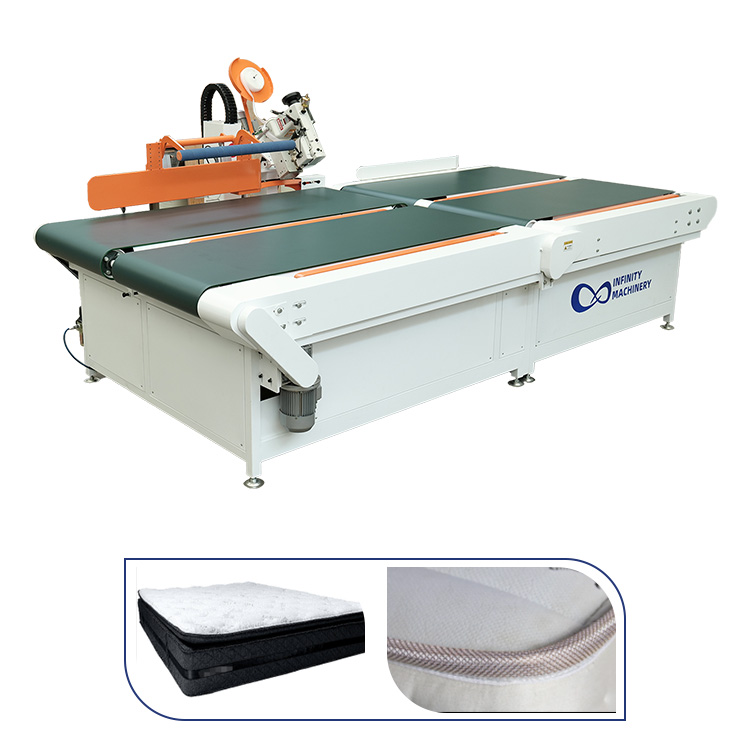
The tape edge station is the most labor-heavy step in mattress finishing: the operator guides the mattress, controls the machine speed and manages every corner turn. On a semi-automatic machine, one operator produces 25 to 35 units per shift; on an automatic machine, one operator produces 50 to 70 units per shift, and the labor cost per unit drops by roughly half. The IF-T4 Automatic High Speed Mattress Tape Edge Machine delivers that step change, and the IF-T3 Singer 300U Head is the semi-automatic baseline it replaces. This guide gives the labor math, the machine comparison, the payback model and the upgrade plan.
The tape edge station closes the mattress edges with the border tape, and it is the manual bottleneck of the finishing line. The operator loads the mattress, guides it through the machine, steers the corners, trims the tape ends and stages the finished unit, and the guiding and steering are the skilled parts that cannot be skipped. The station limits the line: the quilting, border and packing stations run at their rated speed, but the tape edge station runs at the operator speed. The labor cost is the station signature: tape edge labor is 15 to 25 percent of the total finishing labor, and the station is where the automation upgrade pays the fastest.
The operator count tells the story. A semi-automatic machine needs one skilled operator per machine, and the machine is idle while the operator stages the next unit. An automatic machine keeps the operator loading and unloading while the machine runs the cycle, and one operator covers the machine with time to spare. The labor cost per unit is the ratio that changes: the semi-automatic line spends 3 to 5 minutes of labor per unit, the automatic line spends 1.5 to 2.5, and the half is the title of this guide.
The labor saving is structural, not marginal: the automatic machine removes the guiding and steering work, the two tasks that take the operator hands and attention for the whole cycle. The remaining work, loading, unloading and monitoring, is the part that one operator does easily at 50 to 70 units per shift.
The upgrade changes four things on the machine: the feeding, the cornering, the trimming and the speed control. The semi-automatic machine feeds the mattress and requires the operator to guide it straight; the automatic feeds with a motorized conveyor that keeps the mattress aligned. The corner is the biggest difference: the semi-automatic operator steers each corner by hand, the automatic turns the corner automatically with the head lifting and repositioning. The tape trimming is manual on the semi-automatic, automatic on the IF-T4. And the speed control shifts from the operator foot pedal to the machine program, which runs the rated speed consistently.
The IF-T4 automatic machine runs at high speed with the chain stitch that holds the tape edge seam, and the automatic corner turning is what makes the higher speed possible without the operator steering. The skill requirement also drops: the semi-automatic machine needs an experienced operator who knows how to steer corners without puckering; the automatic machine needs a loader who monitors the cycle, trainable in days instead of weeks.
The labor math runs on the units per shift and the operator cost. Take a factory running 200 units per day on a 10-hour shift. The semi-automatic line needs 6 to 8 machines with 6 to 8 operators to reach 200 units; the automatic line needs 3 to 4 machines with 3 to 4 operators. At an all-in operator cost of 300 dollars per day, the semi-automatic line spends 1,800 to 2,400 dollars per day on tape edge labor, and the automatic line spends 900 to 1,200 dollars. The saving is 900 to 1,200 dollars per day, the half in the title, and it repeats every operating day.
The second labor saving is the skill mix. The semi-automatic line needs skilled operators, who cost more and are harder to find; the automatic line needs loaders, who cost less and are easier to hire. The factory that upgrades also absorbs the natural attrition: the operators who leave are not replaced, and the line runs with the smaller automatic crew. The math is strongest when the factory is capacity-constrained: the automatic line reaches the target with half the floor space and half the crew.
The payback is the upgrade cost divided by the monthly saving. The IF-T4 automatic machine costs 15,000 to 25,000 dollars more than the semi-automatic machine it replaces, and the monthly labor saving is 2,000 to 4,000 dollars on a 200-unit factory. The payback is 6 to 9 months, and the machine then runs as pure savings for its service life. The payback math improves with volume: a factory at 300 units per day pays back in 4 to 6 months, while a small factory at 100 units per day pays back in 10 to 14 months.
The payback also counts the quality and rework saving: the automatic machine turns corners consistently, so the tape edge seam is uniform and the rework rate drops. The rework on the tape edge is expensive because the unit has to be un-taped and re-taped, and a 5 percent rework rate on a 200-unit factory is 10 units per day of double labor. The automatic machine cuts the rework, and the saving adds to the labor math.
The upgrade runs in five steps and keeps the line producing during the change. Step 1: the baseline audit, measuring the current units per shift, the operator count, the labor cost per unit and the rework rate, to set the before numbers for the payback. Step 2: the pilot, installing one IF-T4 automatic machine next to the semi-automatic line and running the same product mix, to confirm the units per shift in the real factory conditions. Step 3: the comparison, measuring the pilot against the baseline and confirming the half-labor result. Step 4: the rollout, replacing the semi-automatic machines one by one as the pilot numbers confirm, reallocating the operators to the loading and monitoring roles. Step 5: the consolidation, moving the border work that pairs with the tape edge onto the machines that complete the finishing package, and locking the new labor standard.
The border flanging machine pairs with the tape edge upgrade: the IF-SB-C1 handles the cover flanging that feeds the tape edge station, and the automatic pair runs the finishing line with the smallest crew. The factory that runs the five steps cuts the labor cost without a shutdown, and the pilot protects the investment by proving the numbers before the rollout.
The automatic tape edge machine cuts labor costs in half because it removes the two skilled tasks, the guiding and the corner steering, that take the operator hands for the whole cycle. The remaining work, loading, unloading and monitoring, is the part one operator does easily at 50 to 70 units per shift, and the labor cost per unit drops from 3 to 5 minutes to 1.5 to 2.5 minutes.
The IF-T4 automatic machine delivers the step change, the IF-T3 Singer head is the semi-automatic baseline it replaces and the IF-SB-C1 completes the finishing pair. With the baseline audit, the pilot, the comparison and the rollout, the factory cuts the labor cost without a shutdown and pays back the upgrade in 6 to 9 months. Contact our engineers for a tape edge upgrade study for your line, a pilot plan and a payback calculation based on your units per day and operator cost.
Contact our engineers today for a tape edge upgrade study for your line: the baseline audit, the IF-T4 pilot plan, the labor math for your units per day and a payback calculation based on your operator cost.