When a client in Vietnam first called me, they had a 2,000 m² empty hall, a container of foam, and a dream of shipping their own-branded mattresses to Australia. Six months later they were still hand-stitching borders with three workers and a borrowed sewing machine, making 40 beds a day, and losing money on every one. The problem was never demand. It was that they had bought machines like groceries—one here, one there—with no line connecting them.
The fix was the IF-APL Mattress Automatic Production Line: a single, integrated system that takes raw foam, spring, and fabric and delivers a finished, quilted, taped, and rolled mattress at the other end. This is the guide I wish I had handed them on day one.
Most first-time mattress makers do it the hard way. They buy a foaming machine from one supplier, a spring coiler from another, a quilting machine from a third, and a tape-edge machine from a fourth. Each arrives as a standalone island. Between the islands sit workers carrying panels by hand, mismatched conveyor heights, and a planner spending half the day figuring out why the quilting station is starved while the tape-edge station is buried.
That piecemeal layout is where margin dies. Every hand-carry is a defect opportunity. Every mismatched interface is downtime. Every separate control system is a training burden. By the time you add the labor, the scrap, and the missed deliveries, the “cheap” island approach costs more than a proper line would have.
The smart way is to start with the line and let the machines fill it. The IF-APL Mattress Automatic Production Line is designed as one connected system: raw material in, finished mattress out, with material handling, PLC coordination, and quality checkpoints engineered in from the start—not bolted on later.

The IF-APL Mattress Automatic Production Line is a full automatic production line that produces a mattress from raw material to a finished mattress. It provides the full service and equipment for a mattress factory—layout design, machine supply, installation, commissioning, and operator training, all from one supplier. Whether you build foam, latex, or pocket-spring mattresses, the line is configured around your product mix rather than forcing your product to fit a fixed machine.
The simplest way to think about the IF-APL is this: it is not a machine you bolt between two others. It is the factory, delivered as one system. You supply the building, the utilities, and the raw material; the line supplies the throughput.
The comparison is not really about one machine being faster than another. It is about the islands forcing labor and defects into every gap, while the line removes the gaps. The same building that made 60 hand-built mattresses a day can make 200–300 on a coordinated line.
Most of our customers go from empty hall to running line in roughly 10–14 weeks. Here is the path:
Step 1 — Define your product and volume. Decide foam, latex, or pocket-spring, and your target mattresses per shift. This sets the line configuration. A pure foam plant is simpler than a mixed spring-and-foam plant, and Infinity sizes the stations accordingly.
Step 2 — Receive the factory layout. Infinity returns a scaled floor plan showing machine positions, conveyor runs, utility drops, and operator stations. You build the civil works and power to that plan—no guesswork.
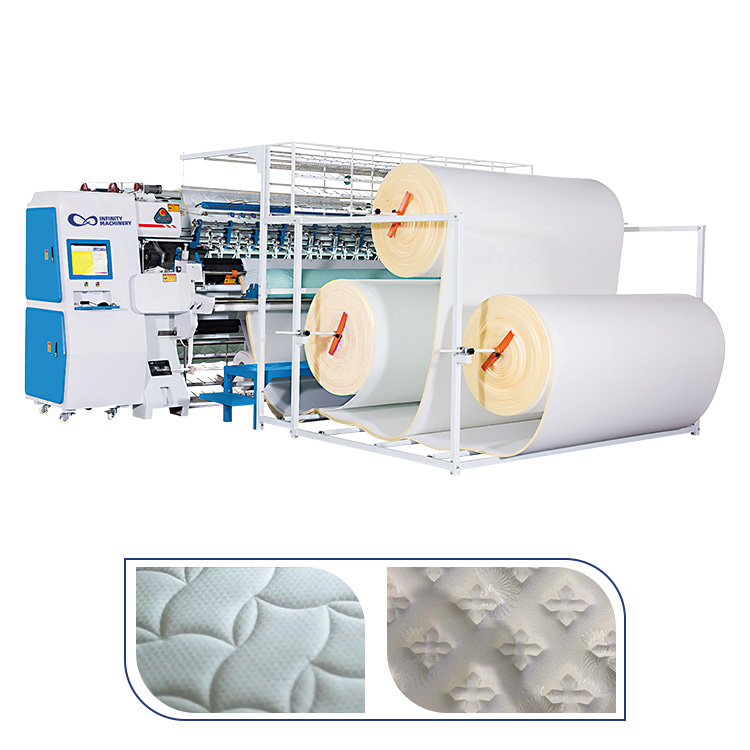
Step 3 — Install the core stations. The IF-FF3 box foaming machine (or spring coiler for spring plants) feeds the line. Upstream foam cutting and laminating prep the cores; the IF-Q-1200 quilting machine quilts the ticking; the IF-P130-1 pocket-spring machine builds the spring units.
Step 4 — Connect the middle of the line. Panel lay-up, quilting-to-border transfer, and the IF-T4 tape-edge machine close the mattress. Conveyors move the work; the PLC balances the buffer so no station starves.
Step 5 — Add the finishing and packing end. For exporters, the IF-CR2 roll-packing machine sits at the line exit, compressing and rolling finished mattresses so 4× more fit per container.
Step 6 — Commission and train. Infinity installs, tunes the PLC recipes per mattress type, and trains your operators on the single HMI. Within days your team runs the whole line, not five separate machines.
The Vietnam client I mentioned at the top was making 40–60 mattresses a day with 14 workers, hand-carrying panels between four unrelated machines. Defects ran high, deliveries slipped, and the math did not work. After installing the IF-APL configured for a foam-and-latex mix, the same hall now runs 240 mattresses per shift with 6 operators.
Labor dropped by more than half. Defects fell because quilting registration and border alignment are checked in-line instead of at the end. And because the line ends at roll packing, their Australia-bound containers now carry 4× the product. The line paid for itself in under eleven months on labor and freight savings combined.
The same building, the same people, a different system. That is the whole argument for starting with the line instead of the islands.
Can the IF-APL handle both foam and pocket-spring mattresses?
Yes. The line is configured around your product mix. Foam and latex plants emphasize cutting, laminating, and quilting; spring plants emphasize pocket-spring assembly and downstream borderless rolling. Mixed plants run both by switching PLC recipes per mattress type.
How long does it take to go from empty hall to running line?
Typically 10–14 weeks: layout design, civil and utility build-out, machine installation, commissioning, and training. Starting with one turnkey supplier is faster than coordinating four or five vendors in parallel.
How many operators does the line need?
A typical IF-APL line runs with about 5–7 operators per shift, versus 12–18 for a piecemeal island layout. One supervisor monitors the whole line from a single HMI.
What is the output of a full automatic line?
Depending on mattress type and line configuration, expect roughly 150–300 finished mattresses per shift. That is 3–5× the throughput of a manual island layout in the same floor area.
Do I need to source conveyors and transfers separately?
No. Material handling—conveyors, lifts, and transfer stations—is part of the IF-APL design. You are not left bolting incompatible systems together after the machines arrive.
What about after-sales support?
Infinity provides installation, commissioning, and training, plus remote diagnostic support so engineers can log in to diagnose faults and tune parameters—keeping downtime short when something goes wrong on a night shift.
Infinity Mattress Machinery builds the full range of mattress production lines, from foam machines and spring machines to quilting, tape-edge, and roll-packing. The IF-APL is the system that turns those machines into a factory.
Tell us your mattress type and target output. We will design the IF-APL line layout, size the stations, and quote the full turnkey package—from raw material to finished, rolled mattress.