In any modern mattress production facility, the sewing and finishing department is the ultimate gateway to product quality and factory throughput. Within this department, the tape edge station (the border-closing operation) represents the most demanding, labor-intensive, and critical bottleneck in the entire plant. While pocket spring forming and panel quilting have transitioned into highly computerized, hands-off processes, tape-edging has traditionally remained anchored to manual human labor. Traditional push-table tape-edging requires physical stamina and specialized motor skills, making it the most vulnerable operational dependency in modern factories. Infinity Mattress Machinery has revolutionized this finishing bottleneck with the IF-T4 and IF-T5 automatic high-speed tape edge machines. By combining advanced air-flotation physics, synchronized servo systems, and heavy-duty mechatronic engineering, these systems transition the final structural seam of the mattress from a manual struggle to complete automatic autopilot.
To truly appreciate the value of tape edge automation, one must first analyze the physical reality of the traditional manual sewing room. Tape-edging is the final assembly step in mattress manufacturing where the top and bottom quilted panels are sewn directly to the vertical border fabric using a heavy-duty binder attachment and a sewing head. This process creates the structural "perimeter framework" of the mattress, sealing all internal comfort layers, pocket spring units, and protective flame-retardant barriers inside. Because the mattress is thick, bulky, and heavy, manual tape-edging is a grueling physical task. The operator cannot stand still; they must walk continuously around a stainless steel table, leaning forward at an awkward angle of 30 to 45 degrees to align the binder needle, while simultaneously using their hands to guide the heavy mattress and stretch the border tape under uniform tension.
The mathematical numbers behind this manual labor are staggering. A standard Queen-size mattress has a perimeter of approximately 7.2 meters, while a King-size mattress exceeds 8.0 meters. To complete a single mattress, the operator must walk around the table twice (once for the top seam, once for the bottom seam after manual flipping), covering a walking distance of at least 15 meters per mattress. Factoring in additional steps for positioning, starting, stopping, and manual turning, a single operator walking at a slow pace covers nearly 500 meters of walking for every 10 mattresses completed. In a typical high-volume manual workshop where an operator is expected to close 60 mattresses per 8-hour shift, they must walk up to 3.5 to 5.0 kilometers daily, all while leaning forward, twisting their torso, and pushing a mattress that weighs anywhere from 30kg to 80kg.
This extreme physical strain has immediate, costly consequences for mattress factory owners. First, finding and retaining skilled tape edge operators is an ongoing crisis in the global mattress industry. It takes a minimum of 3 to 6 months of intense daily training for a new worker to acquire the muscle memory and coordination required to sew straight seams and clean, rounded corners. Because the work is so physically punishing, employee turnover at manual tape edge stations is exceptionally high. Factories must pay premium wages—often the highest in the entire plant—to retain master tape edge operators. Second, human physical fatigue directly correlates with quality defects. During the first two hours of a shift, an operator's stitches are neat and tight. However, as physical exhaustion sets in during the afternoon, their walking pace becomes uneven, leading to inconsistent stitch density, skipped stitches, puckered tape borders, and sloppy corners that ruin the luxury look of the finished mattress, leading to a high rate of customer returns and costly warehouse rework.
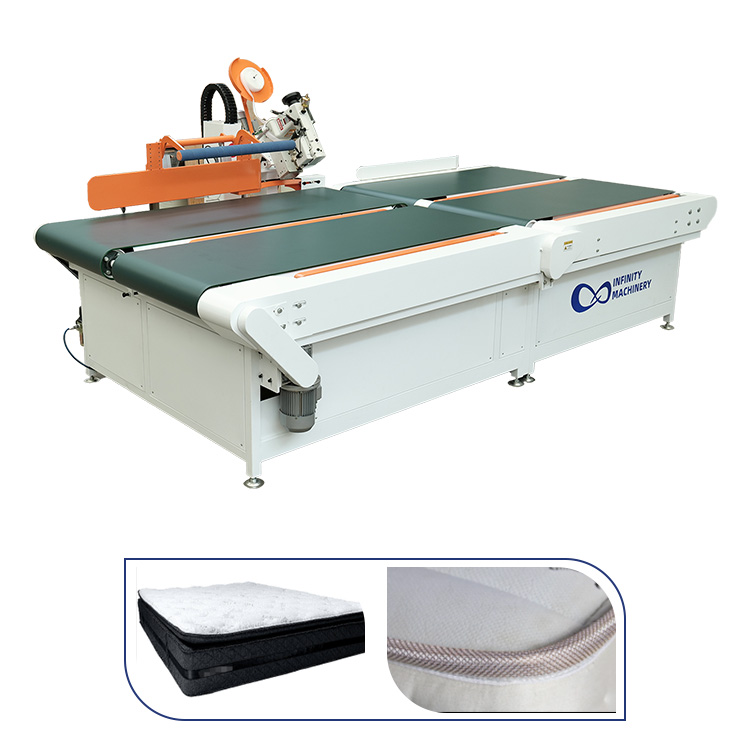
The IF-T4 Automatic High Speed Mattress Tape Edge Machine is engineered to completely eliminate these physical labor vulnerabilities, transitioning the tape-edging station into a highly automated, single-operator workstation. The fundamental engineering breakthrough of the IF-T4 lies in its gravity-compensated air-flotation table. The machine is designed with a massive, polished stainless steel tabletop measuring 2000 x 3950 x 900 mm. Integrated beneath this tabletop is a high-volume, centrifugal air blower system driven by a 2.2KW motor. This blower forces clean, pressurized air through a matrix of hundreds of precision-drilled micro-nozzles in the table plate, creating a uniform, continuous air cushion (air-flotation table) between the tabletop and the bottom of the mattress.
By decoupling the mattress from physical contact with the steel plate, the coefficient of friction is reduced from approximately 0.45 (fabric on steel) to less than 0.02 (fabric on an air cushion). This means a heavy, 60kg queen-size hybrid mattress can be slid, rotated, and maneuvered in any direction with a physical force of less than 20 Newtons—less than 4.5 lbs of pressure. Instead of the operator pushing and pulling the heavy mattress while walking circles around it, the operator remains completely stationary at an ergonomic sewing station. The mattress is gripped by a synchronized central clamping arm and a surrounding motorized conveyor belt carriage. As the sewing head operates, these carriage conveyors glide the mattress along the air-flotation table automatically, feeding the fabric edge into the sewing throat at a perfectly controlled linear speed.
Cornering is the most difficult maneuver in manual tape-edging, but the IF-T4 manages this on complete mechatronic autopilot. The machine’s sewing head is mounted on a balanced, rotary mechanical arm. Precise photoelectric sensors and rotary encoders detect when the mattress corner is approaching the needle. The PLC (Programmable Logic Controller) calculates the relative angular velocity required to rotate the mattress. The conveyor belts and central clamping arm execute a smooth, self-adaptive rotation, pivoting the mattress 90 degrees around the needle throat while the sewing head automatically slows down slightly to maintain a perfectly consistent stitch density and radius. Once the top perimeter is complete, a built-in mechanical lifting arm and flipping grid rise from the center of the table, clamp the mattress, lift it 500mm, rotate it 180 degrees axially, and place it back onto the air cushion. The operator never has to lift a single pound of fabric, and the entire cycle achieves an extraordinary productivity of 18-20 completed pieces per hour.

As consumer sleep preferences have evolved, the market has seen an explosion of luxury hybrid mattresses that combine heavy pocket spring cores with dense layers of memory foam, natural latex, and thick quilted pillow-tops. These luxury mattresses present a severe challenge for standard tape-edging equipment. With thicknesses up to 500mm and weights exceeding 80kg, these massive beds tend to slip on conveyors, require extreme needle penetration force, and suffer from fabric bunching or thread shredding at the needle throat. To address these heavy-duty manufacturing challenges, Infinity Mattress Machinery engineered the IF-T5 Automatic High Speed Heavy-Duty Tape Edge Machine.
The IF-T5 is a mechatronic powerhouse, starting with its direct-drive heavy-duty sewing head running at a lightning-fast speed of 1400RPM. Traditional tape edge machines rely on external belt-drive motors, which suffer from torque loss and mechanical slip under heavy loads. The IF-T5 utilizes an integrated, direct-drive brushless servo motor coupled directly to the sewing main shaft. This design delivers massive, unyielding needle penetration force even at ultra-low speeds, allowing the needle to pierce through thick layers of quilted ticking, flame-retardant fibers, and nonwoven backing materials without stalling or causing needle deflection. The stitch length is micro-adjustable from 3mm to 7mm, allowing operators to customize seam strength and aesthetic stitch pitch via the high-resolution PLC touchscreen.
To manage highly compressible luxury beds, the IF-T5 incorporates an advanced, motorized head lift range of 0-500mm, accompanied by a pair of synchronized, pneumatic pre-compression rollers mounted directly ahead of the binder throat. As the thick mattress moves toward the sewing head, these heavy-duty rollers apply up to 800 Newtons of downward pressure to pre-compress the thick, fluffy quilted layers right before they enter the binder. This ensures the needle only has to pierce a pre-compressed, stabilized fabric stack, eliminating skipped stitches and fabric shifting. Furthermore, the IF-T5 is built on advanced variable-frequency energy saving technology. While conventional systems run motors continuously and waste power, the IF-T5’s electronic inverter system only consumes 1KW under full load—representing a massive power saving that slashes utility bills for high-production facilities.

While the automatic tape edge machine is the star of the finishing department, its performance and the overall structural durability of the mattress depend heavily on the pre-processing stage: flanging. Flanging is the critical process of overlocking (serging) the edge of the quilted top/bottom mattress panels and sewing a high-strength non-woven fabric strip (flange) to it. If a manufacturer attempts to tape-edge a mattress without this pre-process, the decorative tape-edge seam is forced to carry the entire structural tension of the mattress panel. When a person sits on the edge of the bed, the localized downward force pulls on the panel fabric, placing immense tensile stress (suture stress) directly on the tape-edge seam. Over time, this stress leads to thread breakage, popped seams, or tearing of the cover fabric.
By utilizing the IF-SB-A1 Automatic Flanging Machine, this suture stress is completely eliminated. The IF-SB-A1 pre-sews a durable non-woven flange strip directly to the panel edge. This flange is subsequently pulled down and hog-ringed or stapled directly to the perimeter spring wire of the pocket spring unit during final assembly. This ensures that all sitting, sleeping, and handling loads are transferred directly to the internal steel spring core, protecting the decorative tape-edge seam from structural tension and preventing edge collapse. Running at an ultra-high speed of 4000RPM, the IF-SB-A1 easily accommodates panel thicknesses from 10mm to 90mm with its 19mm presser foot height.
The IF-SB-A1 features an advanced PLC microcontroller and touchscreen control panel that synchronizes the panel feed conveyor with the sewing head. It incorporates an automatic backing fabric feeding system and a thread break auto-trimming mechanism. If the thread breaks during high-speed sewing, the machine halts instantly, and the non-woven backing fabric is automatically trimmed cleanly, eliminating manual scissor work and reducing material waste by 30%. Furthermore, panels processed by the IF-SB-A1 have compressed, perfectly sealed flat edges. When they arrive at the IF-T4 or IF-T5 tape-edging station, they slide effortlessly into the binder, experiencing zero fabric bunching or resistance, which increases tape-edging efficiency by an additional 25%.
For mattress factory owners, transitioning from manual push-table tape-edging to an automatic station like the IF-T4 or IF-T5 is not merely an upgrade in product quality; it is a major financial decision that delivers massive, measurable operational savings. To illustrate this, let us analyze a typical medium-sized mattress manufacturing facility producing an average of 150 premium mattresses per day (running 1 shift of 8 hours, 250 working days per year).
In a Manual Tape-Edging Configuration, given an average manual closing rate of 5 to 6 mattresses per hour per skilled operator, the factory requires 3 manual tape edge stations running simultaneously to hit the daily target of 150 mattresses (3 stations * 6 pcs/hour * 8 hours = 144 mattresses, requiring slight overtime).
In an Automated Configuration with the IF-T4 or IF-T5, because the machine operates at a high-speed sustained rate of 20 mattresses per hour on complete autopilot, the factory only requires 1 single automated station to comfortably complete the 150 mattresses daily target in less than 8 hours (1 station * 20 pcs/hour * 7.5 hours = 150 mattresses).
Financial Summary: By transitioning to the automated tape-edging station, the manufacturer achieves a net annual operational savings of $272,000 - $57,000 = $215,000 per year! For a complete capital investment of approximately $180,000 (which covers the IF-T5 heavy-duty machine, shipping, certified on-site installation, and operator training), the payback period is calculated as: Payback Period = ($180,000 / $215,000) * 12 months = 10.04 months. Within less than 10 months, the investment is fully recovered, and the factory enjoys an ongoing $215,000 annual cash flow boost.
Q1: How does the gravity-compensated air-flotation table handle mattresses of highly varying weights?
A1: The air-flotation table uses a high-volume centrifugal blower that micro-adjusts its output velocity. When a light mattress is processed, the air film supports it with low pressure. When a heavy, 80kg hybrid mattress is loaded, the weight naturally compresses the air cushion slightly, increasing the air pressure locally. This self-regulating fluid dynamics effect ensures that regardless of weight, the mattress remains elevated on a low-friction air film, allowing a single operator to guide it effortlessly with minimal force.
Q2: What is the typical operator training time required for the IF-T4 or IF-T5 compared to manual stations?
A2: Traditional manual tape-edging requires 3 to 6 months of intense practice for an operator to develop the physical stamina and cornering synchronization. With the IF-T4 and IF-T5, all rotation, cornering speed-matching, and mechanical flipping are completely handled by the internal PLC mechatronic system. The operator remains stationary and simply feeds the binding tape. As a result, any standard worker can become completely proficient and run the station at peak productivity in just 2 to 3 days of basic training.
Q3: How does the IF-T5 handle extremely compressible luxury plush materials without skipped stitches?
A3: Extremely compressible pillow-tops tend to bunch up at the sewing binder throat, which causes uneven thread tension and needle skipped stitches. The IF-T5 solves this by incorporating heavy-duty, synchronized pneumatic compression rollers mounted directly in front of the sewing needle. These rollers compress the fluffy quilted layers under high pressure before they enter the binder, feeding a stabilized, condensed fabric stack directly to the needle, which completely eliminates skipped stitches and needle deflection.
Q4: Why does the IF-T5 draw only 1KW of power compared to the 4KW of the IF-T4?
A4: The IF-T4 utilizes a standard multi-phase motor layout and larger pneumatic actuators for its built-in flipping grid and lifting arm. The IF-T5 is engineered with high-efficiency variable-frequency drives (VFD) and a direct-drive brushless servo sewing motor. The direct-drive motor delivers high torque directly to the needle shaft without the friction losses of belts and pulleys, drawing power only during actual sewing cycles. This advanced energy recovery and frequency modulation slash power draw to a mere 1KW.
Q5: How do the micro-nozzles on the air table remain clean and free from fabric lint?
A5: Fabric lint and dust are common in mattress sewing departments. Because the centrifugal blower is continuously forcing pressurized air outward through the micro-nozzles, the positive pressure gradient naturally prevents lint and dust from entering the nozzles. For routine preventative maintenance, we recommend blowing the table surface with a compressed air gun at the end of every shift and wiping the polished steel plate with a lint-free cloth to maintain a smooth surface finish.
Q6: Why is pre-process flanging on the IF-SB-A1 recommended before automatic tape-edging?
A6: Pre-process flanging sew-seals the loose edges of the quilted panel and attaches a high-strength non-woven strip. This flange strip is anchored directly to the internal steel spring core. This transfers all structural sitting load away from the decorative tape-edge seam to the steel springs, preventing seam rupture. Additionally, flanged panels lie perfectly flat, reducing fabric resistance at the tape edge needle binder, which increases tape-edging speed by 25% and ensures a wave-free aesthetic finish.
Q7: Are tape-edged seams produced by these automatic machines durable enough for compression and roll-packing?
A7: Absolutely. Compression and vacuum roll-packing place extreme mechanical shear stress on the mattress seams. The IF-T4 and IF-T5 sew tight, locked chain-stitch patterns with continuous thread tension managed by electronic tensioners. When combined with panels pre-processed on the IF-SB-A1 flanging machine, the edge seams are fully stabilized. These high-integrity seams easily withstand vacuum pressures of up to 95% and tight roll diameters without popping, tearing, or sliding.
Contact Infinity Mattress Machinery to request a customized plant layout design, free ROI financial calculation, or live machine video demonstration.

