Two years ago, our mattress factory was stuck in a frustrating cycle. Our pocket spring production capped out at 200 completed spring units per day — barely enough to build 40 mattresses. We had orders lined up, and we were turning down business because we simply could not assemble pocket springs fast enough.
Late last year, we finally broke through that ceiling and hit 2,000 pocket spring units a day — a 10× increase. The difference? We upgraded our spring assembly line from manual methods to a smart two-machine system: starting with the IF-PA Semi-Automatic Pocket Spring Assembly Machine and later scaling to the IF-PPA Fully Automatic Assembly Machine.
In this post, I'll walk you through exactly how we did it — the numbers, the mistakes, the lessons, and why the IF-PA and IF-PPA combination paid for itself in under 4 months.
Our factory has been making medium-quality mattresses for the domestic market since 2012. By 2025, we had a solid customer base and a growing demand for pocket spring mattresses — the kind hotel chains and mid-range retailers prefer because of their motion isolation and durability.
The problem was our spring assembly process. We were assembling pocket springs manually: two operators feeding pre-coiled springs into a gluing station, then manually aligning and compressing them into spring units. Each unit took about 12 minutes to assemble from start to finish. With two operators working full shifts, we were lucky to finish 18-20 units per shift. That is 35-40 mattresses worth of springs per day.
Here is what that bottleneck was costing us:
We knew we needed to mechanize. The question was: how far to go?
We did not jump straight into full automation. Our budget was limited — around $15,000 for the first phase — and we were not 100% sure the demand would justify a fully automated line. So we started with the IF-PA Semi-Automatic Pocket Spring Assembly Machine.
The IF-PA is a clever machine. It is semi-automatic, meaning the operator still loads the pre-coiled springs into the guide rails, but the machine handles the alignment, gluing, compression, and unit assembly automatically. It uses a mechanical transmission system — no air compressor needed — which kept our factory floor quieter and reduced our power consumption.
| Operation | Semi-automatic — operator feeds springs, machine aligns and assembles |
| Drive System | Mechanical transmission — no air compressor needed, low power consumption |
| Setup Time | Fast mattress specification adjustment — change size in under 10 minutes |
| Output | 450-550 spring units per 8-hour shift with 1 operator |
| Training | 2-3 days for full proficiency. The humanized operating system makes it intuitive. |
The results were immediate and dramatic. In the first week with the IF-PA:
The IF-PA cost us $12,800 delivered. In two months, the labor savings alone covered 60% of the investment. The reduced scrap and rework covered the rest.

The IF-PA Semi-Automatic Spring Assembly Machine — the smart entry point for pocket spring automation
Three months after installing the IF-PA, something unexpected happened. A major mattress retailer approached us wanting 2,000 pocket spring mattresses per month — a contract worth over $340,000 annually. It was exactly the kind of opportunity we had dreamed of, but our production capacity was still not there.
At 480 units/day on the IF-PA, we could produce about 10,000 spring units per month — enough for roughly 500 mattresses. The retailer needed 2,000 pocket spring units per month just for their small-size range. To fulfill the full contract, we needed to more than triple our spring assembly output.
That is when we invested in the IF-PPA Fully Automatic Pocket Spring Assembly Machine. Where the IF-PA is a semi-automatic workhorse, the IF-PPA is a fully autonomous production line that requires minimal human intervention.
| Operation | Fully automatic — feeds, aligns, glues, compresses, and outputs spring units autonomously |
| Control | Full CNC with programmable spring count, unit dimensions, and glue patterns |
| Air Pressure | Very low demand; mainly uses mechanical transmission for efficiency |
| Floor Space | Very compact footprint — saved us valuable workshop area compared to alternatives |
| Output | 1,800-2,200 spring units per 8-hour shift with 1 operator for monitoring |
The IF-PPA was a game-changer. It accepts pre-coiled pocket springs from a hopper feed, aligns them automatically using CNC-controlled guides, applies hot-melt adhesive with precision nozzles, compresses the unit to the required density, and outputs a finished spring unit ready for mattress assembly — all without an operator touching the springs.
We installed the IF-PPA alongside the existing IF-PA. Now the IF-PA handles our standard production runs (single-zone, consistent spring counts), while the IF-PPA takes on the complex multi-zone, high-density, and bulk orders. Together, they produce over 2,500 spring units per shift.
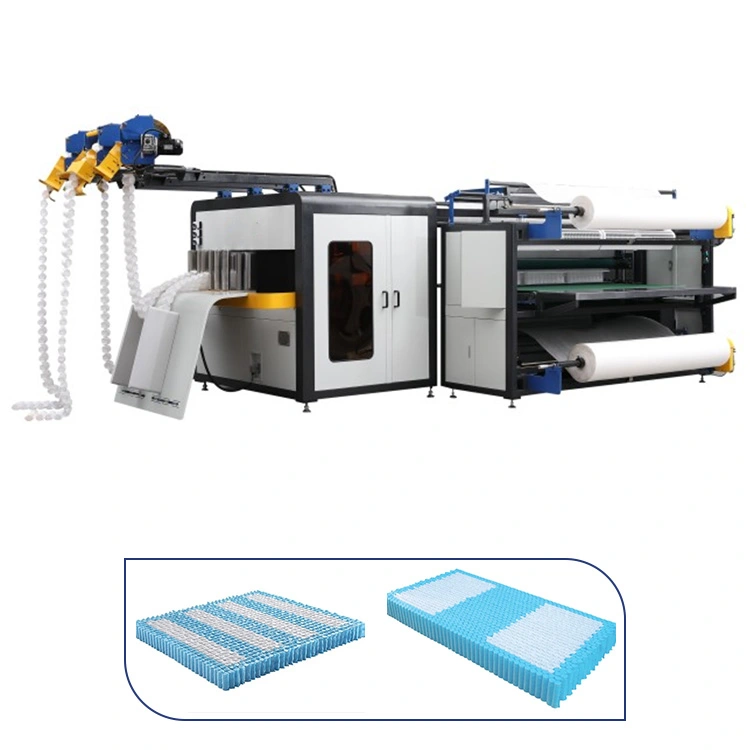
The IF-PPA Full Automatic Assembly Machine — CNC-controlled, high-speed, and compact
| Metric | Manual Assembly | With IF-PA | With IF-PA + IF-PPA |
|---|---|---|---|
| Daily output (spring units) | 200 | 480 | 2,500 |
| Operators required | 2 | 1 | 2 |
| Springs per operator per day | 100 | 480 | 1,250 |
| Failure/reject rate | 6% | 1.2% | 0.8% |
| Monthly capacity (mattresses) | 350 | 840 | 4,300 |
| Monthly labor cost (spring assembly) | $4,800 | $2,400 | $3,200 |
The key insight: labor cost went UP slightly when we added the IF-PPA (from $2,400 to $3,200), but output increased by 5×. The cost per spring unit dropped from $0.50 (manual) to $0.12 (IF-PA) to $0.03 (IF-PPA). The IF-PPA alone produces more units in one day than our manual team could in two weeks.
One question we get a lot: why keep both machines instead of just buying the IF-PPA and selling the IF-PA? The answer is flexibility.
The IF-PA is excellent for:
The IF-PPA is best for:
Having both machines gives us the ability to run two parallel production lines at different volumes. When the retailer contract kicked in, we dedicated the IF-PPA to their order (running 3 shifts during peak) while the IF-PA kept serving our existing wholesale customers without interruption.
Based on our experience, here are the three machines that every growing pocket spring factory should consider. The first two are what we run daily. The third is the next step we are planning for our own expansion.
Looking back at our two-year journey, here is the honest advice we would give to any factory considering pocket spring assembly automation:
1. Start semi-auto, scale to full auto. The IF-PA was the right first step for us. It proved the ROI of mechanized assembly with a modest investment. Once we had the volume to justify the IF-PPA, we already had a trained operator and a proven workflow. Trying to jump straight to full automation would have been riskier and harder to justify on paper.
2. Don't underestimate the importance of spring coiling quality. The IF-PA and IF-PPA assemble springs — but the quality of the assembled unit depends entirely on the quality of the individual springs. If you are still buying pre-coiled springs from a supplier, or using an outdated coiling machine, the assembly machine cannot fix bad spring geometry. We upgraded to a better coiler — the IF-P180-2 dual wire pocket spring machine — before our IF-PPA arrived, and it made a huge difference in our finished unit consistency.
3. Mechanical drive is a real advantage. Both the IF-PA and IF-PPA use mechanical transmission systems with very low air pressure demand. This matters more than you might think: no noisy compressor running in the background, lower electricity bills, and fewer maintenance issues. Our workshop is noticeably quieter and cleaner than before.
4. Train your operators on the IF-PA first. The semi-automatic machine is intuitive and builds understanding of the assembly process. Operators who trained on the IF-PA transitioned to the IF-PPA in under a week because they already understood the material flow and quality checkpoints.
5. Multi-zone is the future. The mattress market is moving toward zoned support — different spring firmness in different areas of the mattress. The IF-PPA's CNC control handles this naturally. If you are buying a new assembly machine, make sure it can program multi-zone patterns. Both IF-PA and IF-PPA offer this capability, but the IF-PPA does it at production scale.
Before we automated, pocket spring assembly was a bottleneck that limited our entire business. Every contract we won created stress on the spring line. Every new customer inquiry made us nervous about capacity.
Now, spring assembly is the easiest part of our production. The IF-PA and IF-PPA run reliably day after day. Our operators are focused on quality monitoring instead of manual labor. And we have capacity to grow into — the IF-PPA is currently running at about 70% utilization, giving us room to take on the next big contract without another equipment investment.
If you are reading this and recognizing your own factory in our story, here is a simple self-check:
If you answered yes to any of these, it is time to look seriously at the IF-PA. It is the most affordable entry point into pocket spring automation, and it will pay for itself in output gains alone within 3-4 months. When you outgrow it — and if your experience is anything like ours, you will — the IF-PPA is waiting as a natural upgrade path.
The pocket spring mattress market is growing at 8-10% annually worldwide. The factories that invest in automated spring assembly today will be the ones capturing that growth. The ones that stick with manual methods will be left competing on price for the low-margin orders that nobody else wants.
Going from 200 pocket spring units a day to 2,500 was not just a capacity improvement — it changed the kind of business we could be. We went from a small factory that could only serve local customers, to a regional supplier capable of taking on national retail contracts.
The IF-PA got us started with a manageable investment and immediate returns. The IF-PPA took us to the next level. Together, they form a spring assembly system that matches any factory's growth trajectory — from 500 mattresses a year to 5,000 and beyond.
If you are where we were two years ago — stuck at a capacity ceiling, unsure whether automation will pay off — start with the IF-PA. You will see the ROI in weeks, not years. And when you are ready for the next step, the IF-PPA will be there waiting.
Our engineers can help you choose between the IF-PA and IF-PPA based on your current production volume, growth plans, and budget. Get a customized ROI projection for your factory.


