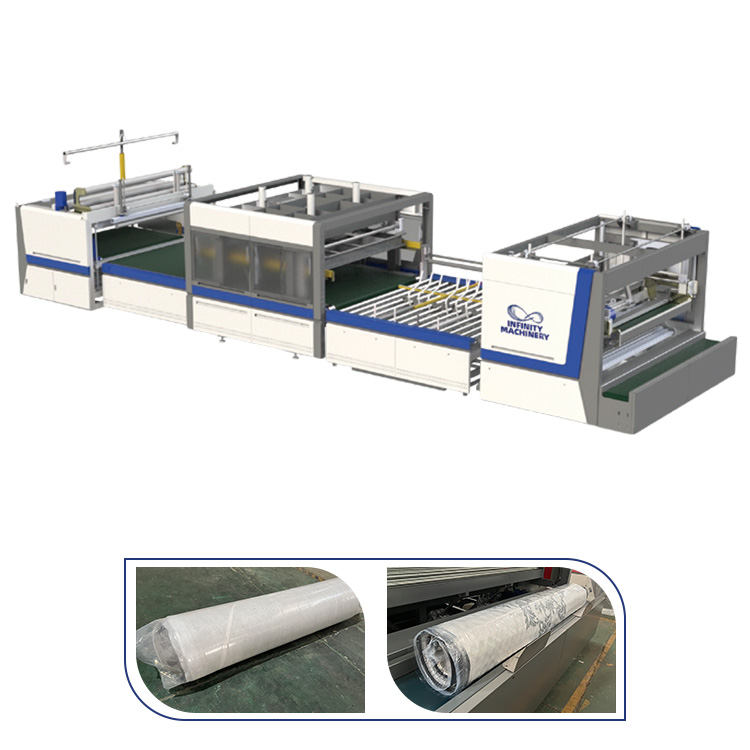
I used to think our mattress packing problem was simple: buy a faster machine and move on. In reality, the problem had three layers. We were losing too much floor space at the end of the line, our team was still handling rolled mattresses more than I was comfortable with, and our export containers were leaving with too much empty air. We finally rebuilt our packing area around the IF-CR2 automatic mattress roll packing machine and the IF-MR automatic mattress roll-packing machine, not because we wanted the biggest line on the market, but because we needed a practical export-packing cell that fit our actual building.
Our factory ships foam, latex, and a limited range of border-free pocket spring models. Packing was happening in a crowded finishing corner that had grown piece by piece over time. We had one compression step, too much manual repositioning, and a staging zone that constantly overflowed. Operators were doing their best, but every extra touch increased the chance of film wrinkles, unstable rolls, label confusion, and loading delays. We considered jumping directly to a full line such as the IF-AMB automatic mattress packing machine, but the economics for our current volume favored a more modular route first.
Six months after the change, we had reduced packing labor by 43%, increased packed units per shift by 58%, lifted average container utilization from 71% to 84%, and cut packaging-related shipment complaints by 61%. The most important outcome, though, was simpler than those numbers: our export packing area finally behaved like a controlled process instead of a daily improvisation.
The old setup did not look catastrophic from a distance. Mattresses were getting packed, trucks were leaving, and staff had learned how to work around the bottlenecks. But once we started measuring the details, the hidden cost became obvious. A mattress that should have been packed cleanly in a controlled sequence was often being compressed, repositioned, rolled, wrapped, moved aside, then repositioned again for staging. Every one of those touches consumed time, created ergonomic strain, and made consistency harder.
We documented six weeks of output and found three repeating losses. First, packaging labor was too sensitive to staffing changes. If one skilled operator was absent, output fell sharply. Second, floor space around the packing zone was being used as a buffer because the team did not trust the process flow. Third, our container planning was based on optimistic roll assumptions rather than repeatable packed dimensions. That meant load plans looked efficient on paper but failed in real life. The warehouse team compensated by leaving safety gaps, which reduced actual container utilization.
Once we turned the issue into numbers, the case for change became easier. On average, we were packing 124 mattresses per shift with five people assigned directly or indirectly to the area. Average end-of-line WIP peaked at 39 units, container fill averaged 71%, and we were spending about $3,950 per month on avoidable labor, extra film use, relabeling, and shipping inefficiencies. The process worked, but it was not disciplined enough for the export scale we were trying to reach.
| Metric | Old packing area | Target after upgrade |
|---|---|---|
| Packed mattresses per shift | 124 | 190+ |
| Packing labor assigned | 5 people | 3 people |
| Average container fill | 71% | Above 82% |
| WIP waiting at end of line | 39 units | Below 20 units |
| Acceptable payback | Not above 10 months | Preferred below 7 months |
There is a strong temptation in packaging projects to look for one “ultimate” machine. If you have the volume, space, and product mix for a high-automation layout, that can be the right decision. We did examine the fully integrated route, and for some factories the IF-AMB is exactly the right answer. But our problem was more specific. We needed faster compression and more consistent roll formation without overcommitting capital to a footprint we could not yet use efficiently.
That is why the IF-CR2 and IF-MR made sense as a cell rather than as isolated machines. The IF-CR2 gave us the controlled compression, fold, and roll stage we needed for mixed export work. It handled the high-capacity portion of the flow and stabilized cycle time. The IF-MR gave us a flexible roll-packing route for products that did not need the same folding logic, especially foam and latex models. Together they allowed us to separate the packing logic by product instead of forcing every mattress through a single compromise path.
The operational benefit was immediate. Instead of a single overloaded area trying to serve all models equally badly, we had a defined decision rule. High-throughput export orders and products requiring the full compression-fold-roll path went to IF-CR2. Simpler roll-packing programs went to IF-MR. That reduced chaos because the team no longer debated every batch in the middle of the shift. The routing decision was made before the load reached the cell.
The IF-CR2 changed the process where our old packing line was weakest: repeatability. On paper, manual or semi-controlled teams can sometimes match machine cycle time for short bursts. In real life, they cannot maintain stable packed dimensions, uniform film tension, and predictable handling hour after hour. The IF-CR2 gave us a reliable compression, fold, and roll routine that removed variation from the most sensitive part of export packing.
The cycle benefit was obvious. Our team had been averaging about 2.9 minutes per packed export mattress in the congested old layout. Once the IF-CR2 was fully in use for the appropriate SKUs, the effective cycle on those orders dropped to about 1.2 minutes including loading, compression, rolling, wrap check, and transfer to staging. That did not mean every mattress in the building packed at 30 seconds. It meant the controlled part of the cell stopped being the rate-limiting step for the orders assigned to it.
The hidden advantage was dimensional consistency. Export packing is not only about speed. It is about getting rolls that behave the same way in staging, labeling, pallet grouping, and container loading. Once IF-CR2 stabilized the packed form, our warehouse team could plan more confidently. We saw fewer last-minute loading revisions and less pressure to leave safety space around unstable rolls.
The IF-MR mattered because not every order deserved to wait behind the main compression path. We run smaller foam and latex programs that still need efficient export packing but do not require the same treatment as our more complex SKUs. Sending all of that through a single main line would have recreated the same bottleneck we were trying to remove. The IF-MR gave us a second controlled path without demanding a large additional footprint.
In practice, the IF-MR became our pressure-relief machine. When premium export orders occupied IF-CR2, the IF-MR handled the simpler jobs and kept the end of the factory moving. That had a strong scheduling effect. We stopped treating small export batches as annoyances that disrupted the main line. They now had a logical place to run. As a result, planning became calmer and finished goods no longer stacked up simply because the “big packing machine” was busy.
The labor effect was also meaningful. The IF-MR allowed one operator to manage a class of products that previously required more manual coordination. By creating a stable side route, we lowered the total labor pressure on the packing team and reduced overtime spikes during mixed-order weeks.
| Situation | Before IF-MR | After IF-MR |
|---|---|---|
| Small foam orders | Waited behind larger export programs | Ran through a dedicated roll-packing route |
| Shift labor balance | Frequent manual reassignment | More stable one-operator support flow |
| Packing WIP | Overflow during mixed weeks | Lower because product classes were split logically |
| Space pressure | High near the main line | Lower because support work had its own lane |
Most buyers first ask about labor savings. That matters, but in our case the more strategic win was space. Before the new cell, the packing zone kept swallowing nearby space because WIP had no rhythm. Once IF-CR2 and IF-MR were routed properly, we cleared enough area to create a cleaner staging path, safer forklift access, and a more disciplined outgoing inspection point. In a factory that cannot easily expand, that is equivalent to buying useful square meters without touching the building.
We measured usable end-of-line space before and after the change. The new packing logic freed roughly 31 square meters that had previously been acting as accidental storage. That space now supports labeled export staging and faster container preparation. More importantly, it reduced friction between finishing, packing, and loading teams. When each department can predict where product will sit next, arguments disappear.
The container result came from the same discipline. Because packed rolls were more consistent, our team could group and load with more confidence. Average fill rose to 84%, and on our best repeat programs we reached 87%. That difference translated directly into lower shipping cost per mattress without any heroic effort from the warehouse crew.
We justified the project using a conservative model. We counted only direct monthly savings from the packing area plus shipping improvement from better container use. We did not include sales upside, shorter lead times as a market advantage, or the future value of upgrading to a larger automatic line later. We simply asked whether this cell would pay for itself by making our current export packing more disciplined.
The answer was yes. Labor savings came to about $2,350 per month. Lower overtime and less repacking added another $760. Film and damage-related savings added roughly $540. Better container fill and fewer partial-load penalties contributed around $2,040. That brought the monthly benefit to approximately $5,690. Against a combined investment of about $34,800 for the two-machine cell, our conservative payback was just over six months.
| Combined investment | $34,800 |
| Monthly labor savings | $2,350 |
| Monthly overtime and repack savings | $760 |
| Monthly film and damage savings | $540 |
| Monthly container-efficiency savings | $2,040 |
| Total monthly benefit | $5,690 |
| Conservative payback | 6.1 months |
If your factory has limited packing space and a mixed export product range, I would not start by asking “What is the most advanced machine?” I would ask “Which machine combination removes the most operational friction from the space I actually have?” For our situation, these were the three products that mattered most.
Month one was mainly about routing discipline. The machines were already doing their jobs, but the people around them were still learning which SKUs belonged where and how to keep staging organized. Even so, output improved immediately and end-of-line WIP dropped. Month two was when the warehouse benefit became obvious. Container planning started using more reliable packed-size assumptions, and the number of urgent late-stage changes fell sharply.
By months three and four, the labor picture stabilized. We no longer needed to pull people from neighboring areas just to rescue the packing zone. By months five and six, shipping performance was the strongest proof that the cell was working. Complaint frequency dropped, packed dimensions became more repeatable, and the export team started trusting the daily plan again.
| Month | Units per shift | Container fill | Comment |
|---|---|---|---|
| Baseline | 124 | 71% | Old packing area |
| Month 1 | 156 | 77% | Routing discipline established |
| Month 2 | 171 | 80% | Warehouse coordination improved |
| Month 4 | 191 | 83% | Mixed-order weeks stabilized |
| Month 6 | 196 | 84% | Payback visible and repeatable |
Do not let the wrong question drive the investment. The question is not “Which mattress packing machine is the most advanced?” The real question is “Which packing workflow gives me stable export results in the space and product mix I actually have today?” In our case, the answer was not a single giant leap. It was a two-machine cell that matched the reality of our building and our orders.
I would also recommend measuring container performance before you buy. Many factories know their daily output and labor count, but not their true container fill, repack frequency, or handling touches per unit. Those are the numbers that reveal whether your packing area is merely busy or actually efficient. Once we tracked them honestly, the logic behind IF-CR2 and IF-MR became impossible to ignore.
Finally, choose a route that can scale. The reason I keep mentioning IF-AMB is not to change the story. It is because good equipment planning should include the next step. A modular cell is valuable when it solves today’s problem and still leaves a clear upgrade path for tomorrow’s volume.
The IF-CR2 and IF-MR worked for us because they turned a crowded, labor-sensitive packing corner into a controlled export-packing cell. The IF-CR2 stabilized the high-capacity path. The IF-MR protected flexibility for smaller programs. Together they improved output, reduced labor pressure, raised container fill, and freed floor space that had been trapped inside a messy end-of-line routine.
If your factory is struggling with shipping volume, manual handling, or a packing zone that always feels too small, this is a practical route to evaluate. It is not the only packaging strategy in mattress manufacturing, but for factories balancing export growth with space limits, it is a very credible one.
Tell us your mattress types, daily output, floor space, and container targets. We will help you compare IF-CR2, IF-MR, and the right upgrade path for your factory.